Monday, August 18, 2014

Huangshan Part 1 (7-28)

Sunday I traveled by bus to Tongkou, the town at the base of Huangshan, Yellow Mountain. I was able to purchase a ticket on the same bus leaving Hongzhou as my original ticket. At least I knew what time to go to the station and didn’t have to wait a long time. The trip took 3.5 hours and went through, around and over the lush, green mountains.

When I was walking to my hotel, Simon stopped to see if I needed help. He has a restaurant that has an English menu and name. So I decided I’d eat there that evening. At the hotel, I relaxed in the room for a couple hours. Then I went out to walk around the town. The first thing I noticed was the granite mountain behind me. Low clouds were moving in front of it, changing its appearance every half minute. Next I walked through the town area, which is full of cafes and stores selling snack foods. Food for the tourists is big business here. People were purchasing bagfuls of snacks and instant noodles to take up the mountain. Finally, I went to Simon’s restaurant to eat. When I was almost finished, he arrived. In addition to the restaurant, he also works at a travel agency in the next town. He learned English by talking to his customers over the past 15 years and speaks quite fluently and with very little Chinese accent. He helped me plan traveling to my next destination, which he made sound complicated. He also thought it was too far—about three hours, which is not so far in China—and very touristic. He tried to get me to change my plans, I think so I could book something through him. I paid his agency to purchase a bus ticket and agreed to pay him to drive me to the bus station in the next town. But I kept my plans as I had put a lot of thought into choosing where I wanted to go and wasn’t ready to make changes without a lot of consideration, which there wasn’t time for.

The staff at the hotel desk didn’t speak English. One man seemed to know a little, but the women didn’t speak it at all. When I was trying to ask about leaving my luggage while I stay on the mountain, a high school boy offered to help. He did quite well. The woman used him to tell me that the hotel shuttle would leave for the local bus station at 7:00 AM. It was nice of her to give me that information which I wouldn’t have had if the boy hadn’t helped.

Monday I headed up the mountain. I left the hotel at 7:00 and arrived at the top via cable car at 10:00. First I took the hotel shuttle to the bus station where I got in line for a bus to the cable car. Then I got in line to purchase a cable car ticket. When I was heading to the next line, I noticed a man selling walking sticks and, remembering how much I liked my bamboo walking stick on Emeishan last year, I purchased one and then joined the line to go up. This took 1.5 hours. Fortunately, I could read while I waited and kept my place in the “line.” Most of the time it was a pushing mass with people as close as they could be to each other so no one else could push ahead. After a while, there were barriers dividing the group so the line could be only two people wide. This reduced the pushing. 

There was a commentary in Chinese and English on the way up, but the only bit I understood was that the cable cars transport 2000 people per hour.


When we arrived at the top, the mountain was in a cloud—no visibility at all. It reminded me of arriving at the top of the mountain in Zhongjiajie last year. 


Except on Huangshan the clouds moved faster and after ten minutes there was good visibility. 


It was fun to watch the mountains play peak-a-boo as I walked toward the hotel. 
Sometimes they would change every 15 seconds as the clouds moved around. 


The atmosphere provided by the moving clouds is one of the things the mountain is famous for and that is often featured in paintings.


At noon I checked into the hotel and went to my dormitory room for six women. 


When I entered, the women and girls there cheered. They were two sisters and their teen-age daughters. The older girl will be in 10th grade and speaks English pretty well, especially for her age. She said she and her friends love English and speak English with each other. I was impressed. Her English is better than that of some of the English majors at the university. The family had instant noodle cartons for lunch and gave me one. Then it was time to rest. After getting up early and waiting so long and walking for a couple hours, I was ready for a rest. Another woman arrived while we were resting and left quickly.

At 2:00, the standard time to end the lunch break, we all headed out. We started out walking together, which was nice as it got me going the right direction. Then I was told to go ahead because they had to wait for one of the men. I didn’t see them again until I arrived back in the room in the evening. I got a little confused about the plan the girl had shown me on the map and went on a different trail for a bit. When I reached the cable car down (a different one than I’d gone up on), I realized that wasn’t where I wanted to be and headed back to the other trail.

The destination of the afternoon was Xihai Grand Canyon, a trail that loops around an area with magnificent views. There were many people on the trail, but it was never crowded and sometimes I was walking alone. It wasn’t always well marked at junctures. Sometimes when there was a sign with a map, I had trouble relating what was on the sign’s map to the map I had purchased. I asked for assistance several times throughout the afternoon. 


The trail went up and around and through the mountain. 


Looking back, I realized that what I thought was a path on the mountain was actually a path attached to the side of the cliff. 


The views were stunning.


After a while the trail went down and down and down. I was really glad to eventually see signs pointing toward a cable ropeway. I was surprised to see that there is a cable ropeway because it wasn’t on the maps. By this time I was walking mostly alone. There was a couple who looked about my age and had less idea about where they were going than I did. We had passed each other several times. At one point we looked at a sign trying to decide which way we wanted to go. My map was a little helpful and we agreed on a direction. Walking down, I was glad to see the cableway tracks at the bottom becoming closer. Eventually the couple and I ended out on the same cable ropeway. A lot of people were waiting for it to arrive. 


This cable ropeway has one long car with three sections for people to stand in; so we all could crowd in and go up at the same time.


At the top of the cable ropeway, we still had to walk uphill for fifteen more minutes. After that, I was happy to see that the trail went mostly down until I reached the hotel. 


Soon it was 7:00 and the sun was setting. I could see on the map that there was still a long way to go to get to the hotel. Fortunately, others were also headed that direction. At one intersection, it wasn’t clear which way to go. I asked a woman and she pointed to a man. He was using his GPS to determine which direction we needed to go. We stayed close to each other the rest of the way. When I arrived back in the room at 7:40, the family was happy to see me, as they had been worried. They had returned about twenty minutes before I did. Lights went out at 9:00, and some people were already sleeping then.


Friday, August 15, 2014

Hangzhou Part 2 (7-26)

Having correctly anticipated that West Lake would be crowded on the weekend, the first thing I encountered when I went out Saturday morning was two huge tourist groups. The main sites were packed all day, but in larger places it was possible to not be crowded. When I was planning the trip and reading about West Lake, I learned that one can rent a bicycle and ride around the lake, and I planned to do that. However, I found that I wasn’t really interested once I was here. I was more into walking and enjoying a slow pace. Also, the riding around the lake was riding on the streets or sidewalks among the traffic or walkers, which really didn’t appeal to me. This was more of a walking place.

After visiting a temple honoring a king near the hotel, 


I took a boat to Three Pools Mirroring the Moon, a small island that has three pools. I’d read that the picture on the back of the one yuan note is West Lake. The scene is off this island. The three knobs sticking out of the water that are on the note are roped off so boats can’t go too close. Otherwise no one would see them, as they would be surrounded by boats with people taking their photos next to the famous landmark. As it was, the area just outside the roped-off area was full of small boats that take people close to the famous scene. Although the scene on the money is from the water toward the island, everyone on shore was also having their photos taken with the landmarks in the background.

I spent a few hours walking around and enjoying the beautiful island. It is very small and compact. And it was crowded, but, as always, it was possible to get with smaller crowds sometimes. 


Some of the pools had the huge lotuses, which were blooming, and others had blooming water lilies. 


There are bridges across the pools. 


The island has several pavilions. 


One is in the shape of the backwards swastika, meaning “all is peace.” It is the only building in China in that shape. The weather was overcast, which gave a special atmosphere.


After returning to the mainland, I decided to relax in my room for an hour before heading to another site. This was the first day I stayed close to the hotel, so it was possible and was a good idea. Recharged, I headed to Prince Bay Park. I decided to take a bus there and walk back. The park is an area of green lawns, trees, and carp pools. I could tell it is a popular area because there were several tour groups there.


When I went to purchase corn on the cob, I discovered that my wallet was not in my bag. Either I had missed the bag and dropped the wallet when I was putting it back after getting money for the bus or the man standing close to me on the bus was a pickpocket. His pack was on his front and was above my bag; so if he was a good pickpocket, he possibly could have opened the flap and reached in without my knowing it. I don’t think so, but I have read that such things are possible. At any rate, I no longer had my wallet. The big losses are my driver’s license, my Chinese bank card, and my bus ticket. I didn’t have much cash in it. That is in another mini-bag; so I did still have some cash with me.

As I was leaving the park, it looked and felt like it would rain soon. A short while down the road I came to Leifeng Pagoda and had to go in. It was just beginning to rain when I entered. The pagoda is at the top of a hill, and there is an escalator to go up, stairs for walking down. 


The bottom level of the structure is ruins from the original pagoda, and the new one is built over the ruins. There is an elevator to the top of the pagoda as well as stairs. I opted for the stairs, as you can stop at the six different levels and the line for the elevator was quite long. 


Each level has different features: One has carved wood scenes of the history; one has paintings of the Buddha’s life; 


one has paintings of local areas. 


When I walked through a door on the fourth level, I thought I was walking into another room with paintings on the walls. Then I realized that it was the scene outside. The rain and mist made it ethereal. While we stood there, the wind became very strong and heavy rain began. By the time we got to the top level, there was no view at all—only the rain and white background. By this time, it had become a thunderstorm. Everyone stayed inside the pagoda for an hour and a half while the storm raged. Then it subsided and became just a heavy rain. So I joined those leaving to walk back. Instead of the leisurely stroll along the lake that I had anticipated, I had a quick walk back in the rain.

Since I no longer had my bank card that I was going to use to get cash for the next few days, I had to find a bank where I could use my U.S. card. The young woman at the desk told me that the closest bank is at Wushan Square. So I headed back there again. A policeman pointed me to the bank I needed. I found it, but it doesn’t have an ATM; so I asked the guard where one is. He pointed. A couple minutes later a girl approached from behind and asked if I wanted the Bank of China ATM. I guess she heard me ask the guard, but it was strange. She walked with me for several minutes to the street that has several banks, and we found one that I can use.

Next it was time for dinner. Walking back to the street that goes toward the hotel, I came to the food street I’d seen on Thursday. I chose the restaurant that advertises “We have an English menu.” It also has pictures, but it was such a treat to be able to read what things are and not have to guess. 


I selected a dish described as Hangzhou chicken with special sauce. The picture looked like pieces of chicken wrapped in tofu skin—tofu that is so thin that it is like skin. When I took a bit, I realized that it was not chicken, it was slivers of bamboo wrapped in tofu skin served with chunks of black mushrooms. It reminded me of the description of food that looks like one thing but isn’t, a specialty that was described in The Last Chef, a book about Imperial Chinese cooking which I had recently read. It was interesting to experience that after reading about it.

When I reached the intersection with the hotel’s street, I knew which way to turn. Now that I was familiar with the area, it’s was time to leave, which often happens when traveling.

 Update: Ten days after leaving Hangzhou, I received an email from the booking company saying that my wallet had been found near the hotel and returned to the hotel. I was instructed to contact the hotel by email, which I did. I sent them Peggie’s address in Chinese and asked them to mail the wallet to her. Ten days after sending the email to the hotel I have had no response; so I don’t know what is happening. At least I know that I was not pickpocketed by the young man who I didn’t want to think had done that and that I did indeed drop the wallet when I was not being alert. Somehow I felt better knowing this.


Hangzhou Part 1 (7-25)

Wednesday was travel day—from Wenzhou to Hangzhou. It was a good day to be traveling, as it was raining lightly when I left the hotel and then rained heavily for a couple hours. When I arrived at the station and the security guard told me to “wait a minute,” while he got the English-speaking woman, I knew this was not good. The problem was that my train, on which I’d reserved a seat three weeks earlier, had been “stopped” that day. So I had to change my ticket and take another train. My new train left three hours later than the original one. I was happy it wasn’t longer.

This train trip took three and a half hours. The first part of the trip went along and through the mountains. There were many rice fields between the train tracks and the mountains.

Once in Hangzhou I noticed a sign to the subway and decided to give that a try, remembering the taxi driver in Xi’an who chatted about how I should have taken the metro because it is faster and cheaper. There was a map showing the route with English as well as Chinese. Using my hotel reservation printout, I found the district and selected what looked like a close stop. I did well. When I got off, there were signs to West Lake and then there was a sign to the street I needed. So off I went. Unfortunately, only the first sign to the street had English; so I had to ask for directions a few times. This happens often.

My hotel was close to West Lake, one of the main scenic areas in Hangzhou. After dinner, I walked along the lake for a while, enjoying the evening atmosphere.


I woke up Thursday morning feeling like I could easily overdo it that day and decided to take it easy. First, following my philosophy to plan to get out of town shortly after arriving so I don’t have to worry about it later, I went to the bus station to purchase my ticket to Huangshan. I probably could have gone to the station on Monday and gotten on a bus, but I didn’t want to repeat the Yandangshan experience of having to wait a few hours because I didn’t know what time the train left. Ticket in hand, when I exited the station, I saw a sign to Xixi Wetlands National Park. I had thought about going there but had decided not to because it’s far from the hotel and there are lots of things to do closer. But, there I was, only 1.5 km away from the park. And, since it was raining, it seemed appropriate to visit the wetlands. So I took a taxi there. The rain continued all day, mostly lightly, stopping briefly only a few times. I encountered more English at the park than I have in most places recently. Both young women who sold tickets explained them to me in detail well.
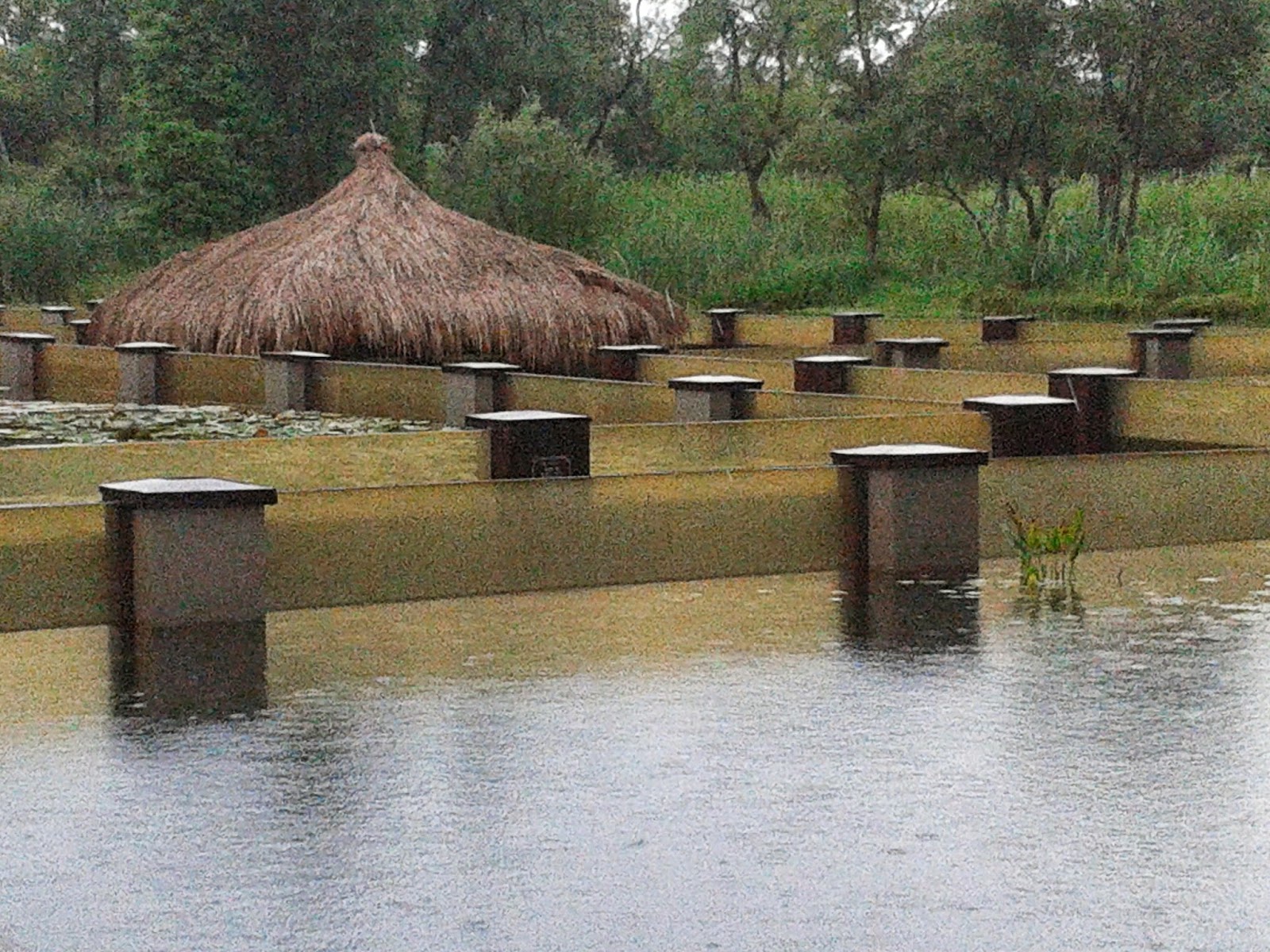
I ended out spending the whole day at the park because I enjoyed it and I didn’t feel like going elsewhere, taking it easy. The first part I walked through, an area full of the huge lotuses, water lilies, and other water plants, was one of my favorites. 


Next I walked through the old street on the way to the “storage battery operated boats” that transport people around the water. (The shuttle buses are also battery operated.) 


On the boat ride, there are four ports to stop at. The longest ride was the first one—half an hour between ports. It’s a peaceful, beautiful ride. 


At that stop, there are a lot of places to walk to, and I went to most of them. The area is beautiful and I was enjoying walking there. Two sites are a nunnery and a temple. The woman at the nunnery greeted me with hands palm to palm. There are a couple lovely, old houses that are now museums. 


The next port has the huge rubber duck that is the park’s mascot. The boat didn’t stop at the fourth port, which was OK, as I was ready to be done. 


Back at the starting point, I exited the area and went to the underwater viewing site I had tried to but couldn’t go to earlier because I hadn’t yet purchased a ticket. I was intrigued enough that I decided I wanted to see it. They’ve constructed Plexiglas tunnels in the water with pathways between them so you can look in to see the plants and fish. It wasn’t spectacular, but it was interesting. 


Then I was done with the park. When I got to the exit, I realized that it wasn’t a good place to get a taxi and ended out walking back to the bus station (1.5 km) to take the bus back to the hotel. I felt good that I knew what to do, as sometimes I’ve been in places that aren’t good to get a taxi and didn’t know what to do.

The park was a perfect way to spend a rainy day when I didn’t want to overdo it.

General observations: Young students seem surprised to see me—a foreigner. On the subway, a boy about ten years old was clearly surprised to see me. His eyes opened widely. He didn’t speak to me, but he did point me out to his friend. When he left, he waved. At the park a few children visibly noticed me. Two girls managed to say “Hi,” which is the greeting I get most in this part of the country. I asked one girl her name, thinking they might know that. They didn’t, but their mothers coached them and they repeated after their mothers. It was fun watching them.

The recording on the metro advises passengers to “please alight on the left side.”

Friday’s destination was China’s Grand Canal, which goes through Hangzhou. At 1100 miles long, it is the oldest and longest canal/man-made waterway in the world. Constructed mostly in the 6th and 7th centuries, it connected Beijing to Hangzhou, linking the Yellow and Yangtze Rivers. Now only the southern part is navigable. Last month it became a World Heritage Site. Since I had learned that it can be accessed by metro, I decided to have a look at it and possibly take a boat ride.

I got to the metro fairly easily. The only kink was that the signs in English stopped—again. There were signs pointing out the direction to the metro until the last intersection. Then the only signs were in Chinese. Fortunately, a cleaning woman was there and pointed the direction for me when I asked. I do find it frustrating when this happens. 

The metro stop for the canal is West Lake Cultural Square. It has a huge shopping center and a museum. It also has an old bridge over the canal. I crossed the bridge and joined the line for boats down the canal. Not sure where they were going, I decided to just get on with the line. When one boat arrived, a number of people got on, but the people around me stayed in line; so I did, too. There are modern boats and old-style, smaller boats. I was glad that the one for us was the latter. The trip took 40 minutes. 

The canal has a lot of barges carrying stones and such up and down, which reminded me of watching the barge traffic on the Mekong delta. 


We went under several bridges decorated with carvings. 


As we approached what turned out to be the stopping point, the canal is lined with traditional houses.


The boat’s destination was the 17th century Gongchen Bridge, the highest and longest arched bridge in the area. 


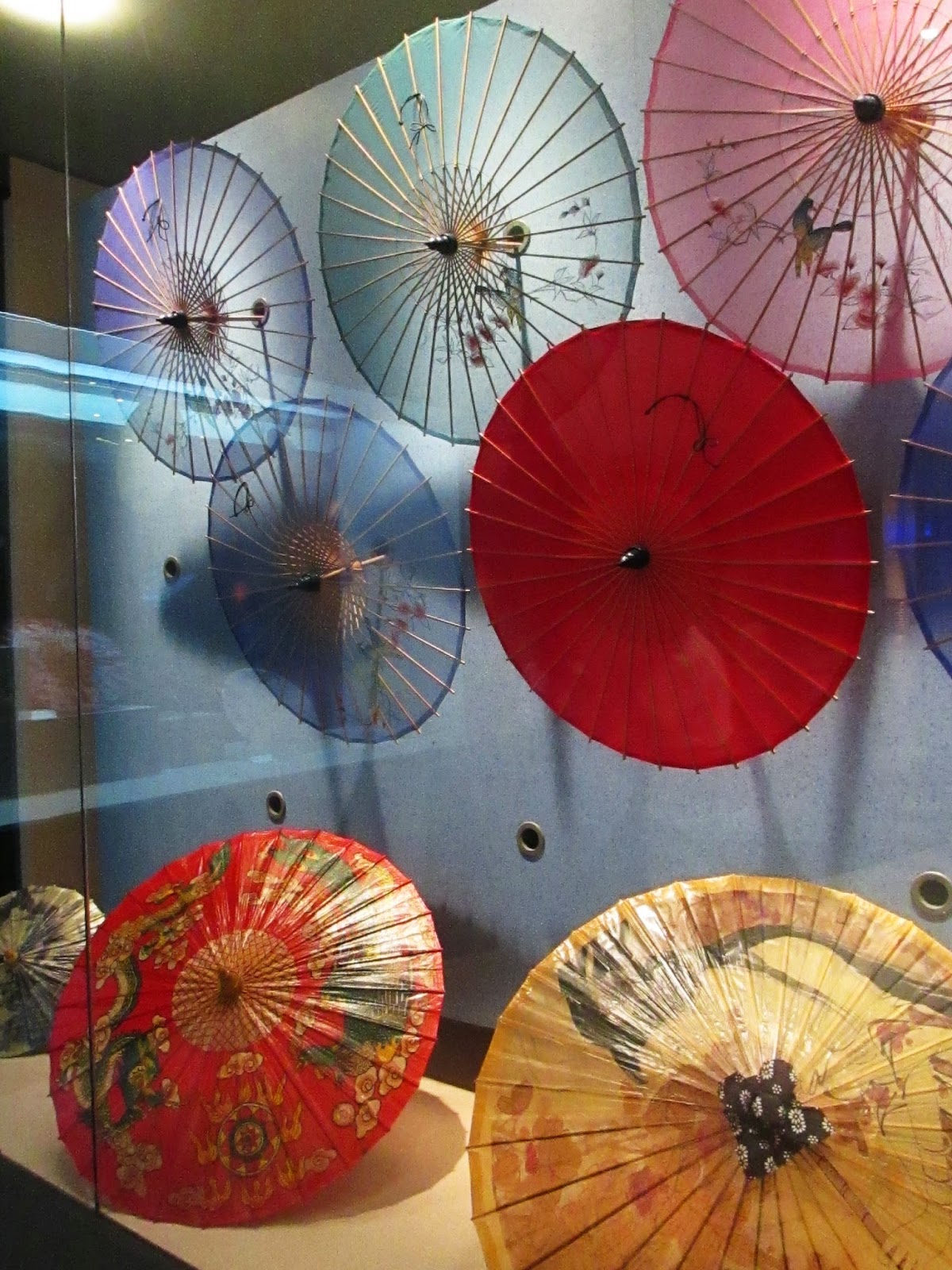
After walking over the bridge, I discovered that the area is a tourist destination and has three museums and a center for demonstrating traditional arts. This was good news for me, as I like museums and arts. First I went to the demonstration center, which has sections demonstrating, among other crafts, pottery, purple clay, oil paper umbrellas, fans, and scissors. 


At the man making traditional scissors, I met two American women about my age who live on the other side of the bridge. They have both lived in Asia for about 30 years and are in the textile business. They have items made here and exported mostly to the U.S. They don’t know Chinese language but had a younger, possibly also American, woman with them who is fluent. They recommended the Swords, Knives, and Scissors Museum.


I started with the Fans Museum. There I learned that fans were first round and then folded. It’s uncertain whether they first started in Japan or China.


I decided that I needed to eat, but this was not a good place to be looking for food. I found one restaurant and went in. The menu presented was in Chinese with no pictures. There are several foods that I can order, but I drew a blank when I looked at the menu. The waiter suggested curry, and we were discussing that when an American man—the third or fourth American I saw that day, which is a record—came over and offered the assistance of his Chinese wife who is fluent in both English and Chinese. She suggested a noodles dish that they were having but said it’s very big. She got the waiters to agree to serve me half an order. Even so, it was a huge bowl and I ate only about a fourth of it.

Next I went to the Umbrellas museum. It features both oil paper umbrellas and silk umbrellas. There was a group of what looked like middle school students running around getting information to record on their brochures. 


Finally I went to the Swords, Knives, and Scissors Museum. Although it was interesting to see the history of swords and knives, it was my least favorite of the three.


Then it was time to head back. The boat that arrived was the modern, faster on, which was fine since I’d had the leisurely trip up the canal. The return took only 30 minutes. 

When I got off the metro, I decided to walk to Wushan Square, which I’d seen on the map and which has an ancient street in the area and which is in the direction I needed to go.  The area has an abundance of old style buildings. 


One area has what they call the beginning of modern buildings—in the early 20th century—combining the new, European style with the traditional style. It was fun to walk around the area looking at the buildings and shops in them. Since it was evening, the area was getting crowded and became more crowded as I walked around. 


Vendors sell all kinds of souvenirs. On the way out I came across a plaza that was divided into three sections: two for line dancing and one for roller skating.


When I arrived back at the intersection with the hotel’s street, I turned left. After an appropriate time, I realized that I hadn’t come upon any of the landmarks I knew and realized that the intersection wasn’t where I thought it was. When I came to a park, I decided to enter it and walk back along the lake, joining the Chinese out for a walk. When I arrived at the hotel, I still had energy for the first time in a few days. It felt good not to be exhausted at the end of the day.