Monday, September 28, 2015

Kandy Part 2 (8-13)

Thursday I hired a tuk tuk for an all-day tour out of the city. It usually includes an elephant orphanage where you can have close encounters—bathing, riding—with the elephants. Since I’d had such experiences and had just seen wild elephants, I wasn’t interested in that. When the guesthouse owner mentioned ancient temples, I knew that was what I wanted to do in addition to the botanical gardens.

On the way out of Kandy, we stopped at a woodworking workshop—and sales center—and one for batik. I was prepared for shopping after talking with a German couple at dinner Wednesday night. They spent all their money before arriving at the botanical gardens and didn’t have enough left for the entrance fee. That wasn’t going to happen to me.

The man at the woodworking workshop demonstrated making dye with a special bark that changes color when different substances are added. I’d seen a quick demonstration of this before, but he took more time. It is amazing to watch the water change color as each substance is added. The batik explanation was also well done. I’m pretty familiar with the process, but it was a good review. A special Sri Lankan technique is the dot technique. Skin is depicted by painting dots before the wax is applied.

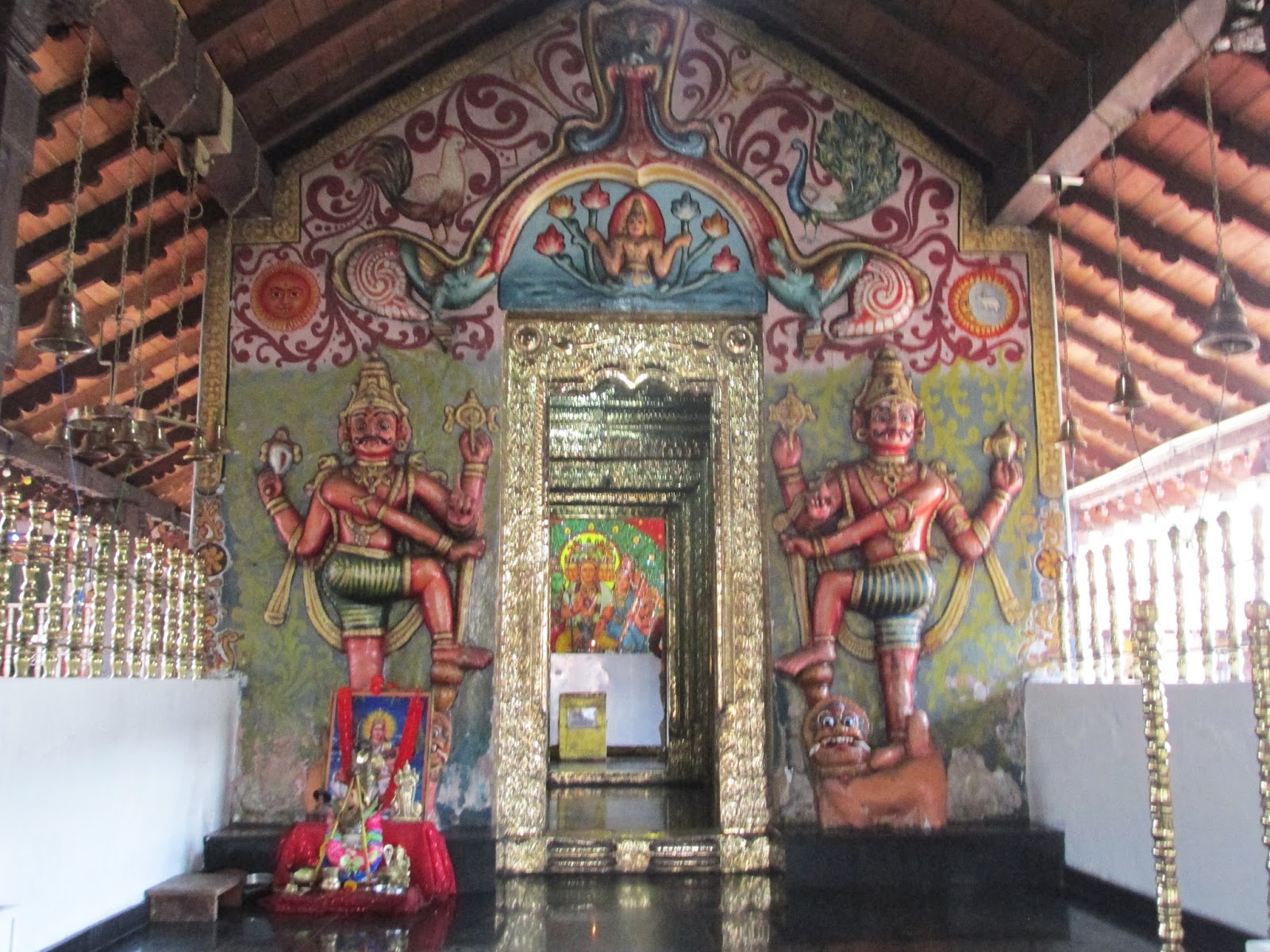
The three ancient—14th and 15th centuries—temples are in small villages. We rode for almost an hour to Embekke Devalya. A special feature of this temple is beautiful wood carving. 


The pillars each have four small, carved pictures, one on each side. 


As I was walking around the building, two men started drumming. So I returned to the central area to see what was happening. After a few minutes, a priest entered and walked into the inner shrine behind the curtain. Then he walked out. A few minutes later he returned carrying two gold cloths on a pole and went to the inner shrine. After several minutes he came out and rang the bells along with the drumming. Then he returned to the shrine and emerged carrying two gold cloths out. Maybe he changed them. While he was in the shrine, I noticed a sign with times, one of which was 11:30. I figured that these were the ceremony times and that my driver planned to get me there in time for the one at 11:30. When we left, he mentioned that.

On the way in to the temple, I noticed a sign that said “toilets for foreigners.” That intrigued me and I needed one; so one the way out I told the driver to stop. He pointed out the building I should go to. The signs on the building were in only Singhalese, which I found interesting since the sign by the road was only in English. The man took me to the correct side of the building, and when I came out, he pointed to the sign that said how much should be paid: 50 rupees/$0.40.

Next was Lankathilaka Temple, which is both Hindu and Buddhist. I had learned at a museum that the two religions started to merge a little in the 14th century; so this was an example of such a temple. (Many modern temples have both Hindu and Buddhist images in different shrines. This is especially common with Ganesh.) One side of the image house is Hindu and the other is Buddhist. The temple is on top of a rock mountain. It features elephants on the outside. 


When I was leaving the Hindu side of image house after looking at everything, a man motioned to me and asked if I wanted to go inside. Of course I did. We went behind the curtain and he opened a door, locking it behind us. 


This was the Hindu shrine, the inner part of which was carved out of the rock and the outer part of which is made from red bricks. 


Each side of the inner part has a niche for an image—three gods and goddesses and one Ganesh. All are 730 years old and are painted beautifully. It was really special to be able to see these statues and the inner shrine. When we finished, he asked me to make a donation to the temple in the donation box. It was well worth the additional donation in addition to the entrance ticket.


The white main entrance on the Buddhist side is a special feature of the temple according to the brochure we were given. Unfortunately, the Buddhist temple was not open.


Gadaladeniya Raja Maha Vihara, the last of the ancient temples on the agenda, is famous for the wall murals in the shrines. The small building has three shrines that were open, each with a painted Buddha statue and murals on the walls. Some are in good condition, and others have parts that can barely be seen. They are amazing. The outside features carved elephants.


The big stone building is being reconstructed. 


It houses the big Buddha statue.


We made a quick stop at a spice garden. The tour wasn’t nearly as good as the one in Sigiriya. The man pointed out several plants that are native only to Sri Lanka. He told how each plant is combined with a number of other spices to make medicine that cures various illnesses and problems. Then he gave me the pamphlet about the products and, after a couple minutes, asked if I was going to buy anything. When I said “no,” he took the pamphlet back and asked for a tip.


The next stop was a tea factory, which was exactly that. It is where tea leaves are processed to make tea that is sold. The young woman who took me around and explained the process was the most indifferent guide I’ve had. She repeated the memorized information with no intonation and then moved on. Perhaps she doesn’t really speak English and can only repeat the memorized speech. I felt no connection with her and felt like she doesn’t enjoy her job. After the quick tour of the factory, we arrived at the sales room where she gave information about the types of tea they sell. I was surprised to see red/rooiboos tea from South Africa being sold at a Sri Lankan tea factory. They also sell flower tea, the balls that open to a flower when immersed in hot water, from China. When I sneezed, she stopped mid-sentence and waited till I finished. Then she finished the sentence. About fifteen seconds later, she started laughing and couldn’t stop. She apologized and then laughed some more. I told her it was OK and that everyone reacted that way. I was glad to see a bit of personality come out. She seemed more at ease after that.

Finally we arrived at the Royal Botanical Gardens. The driver told me that an hour and a half was enough but two hours would be OK for me. I guess he’d noticed that I take a lot of time looking around. The garden is huge, and for two hours I was immersed in its beauty. Everything about the garden is lovely. There is a huge open lawn area near the entrance. 


Another area has a well-manicured flower garden. 


Of course I enjoyed the orchid house. 


A special feature of the garden is palm walks—several paths that are lined with different types of palm trees. 


There were monkey in one area—a different species of macaques that are brown. They were very protective of their babies, holding them tightly and turning so they were hidden from the people. 


In another area I noticed a lot of big birds sitting in the trees. When I zoomed the camera on them, I realized that they were huge bats, and I remembered the woman at the guesthouse had mentioned them. As I made my way back to the entrance just before two hours was over, I was satisfied. I saw almost everything and thoroughly enjoyed my time there.


Dinner was curry again: long beans, daal, white tuna, and cucumber salad. All were delicious.


Since I kept seeing students dressed in school uniforms, I asked the guesthouse owner about that. He explained that they are studying for the university exam. A familiar story.


Kandy Part 1 (8-12)

Tuesday was travel day from Polonnaruwa to Kandy. For the first time, when the bus left the station, it was barely half full. After an hour more people had gotten on, but it still wasn’t full. Later, after stopping in a large town, all the seats were in use. There were half a dozen other foreigners on the bus, which was also a first during my travels. The Sri Lankan man beside me chatted a bit. When he learned that I am not married, he told me he likes me. He repeated this a few times, touching my arm as he said it. Nothing like being flirted with by a man who is at least 25 years younger. Fortunately, his home was before Kandy.

The bus trip was long—4 hours. Instead of a Buddha or Ganesh on the dashboard, this bus had a picture of Jesus on the panel behind the driver. 


After the first couple hours, we were in the mountains with trees and a few good views across the valley. The road wound up and down and around with many turns. The temperature was noticeably cooler. It was raining at the top of the mountains but we drove out of it. When we finally arrived in Kandy, I was more than ready to be off the bus.


Kandy’s elevation is 1600 feet; that of Polonnaruwa is 152 feet. After the last few days of high temperatures and humidity, I was glad to be at the higher, cooler elevation. Temperatures in Kandy have been in the 80s during the day and low 70s at night. Much more pleasant.

The guesthouse is up a mountain. The house itself has five levels that descend down the side of the mountain, which is typical on this mountain. Two levels are for guests; family members live in the other levels. 

Views from the balcony are green. Since my room had a door to the balcony, I ate breakfast there each morning, which was wonderful.

When I was talking to the owner about things to do, I mentioned the dance performances I remembered reading about. He said he could make a reservation for the 5:00 show at the venue near the guesthouse, which he said is the best show in Kandy.  That gave me twenty minutes to rest. He gave me a pot of tea, which was nice. Four French guests were also going to the show, and the owner walked us over. Our seats were in the front row, which surprised me since my reservation had just been made. When I asked, he said that they give him those seats when he makes reservations.

The show, Dances of Sri Lanka, consisted of twelve dances that went from one to the next seamlessly. Both men and women danced accompanied by drums and sometimes a horn. Some were variations of dances I’ve seen in other places—twirling multiple numbers of disc drums, fire dance with fire eating, harvest dance. 


Others were special for Sri Lanka—peacock dance, masked dance. As always, I enjoyed the costumes and dances. After the dances, two men did fire walking—walking on hot coals. It was a good way to start my time in Kandy.


Back at the guesthouse, I had dinner right away as I hadn’t eaten much all day and was hungry. My appetite returned. Dinner was five kinds of curry—okra, mushroom, chicken, lentils, and potatoes. The rice was delicious. The owner’s wife said it is the best Sri Lankan rice. I recognized the name from the menu of the fried rice restaurant I’d eaten at in Polonnaruwa, but I had selected a different kind of rice there.

I spent Wednesday seeing some of the sites in Kandy town. The guesthouse owner provided a map with the main sites highlighted, which was very helpful. I was able to walk everywhere. I didn’t get to all the places I might have enjoyed, but I saw enough at my leisurely pace.

Kandy is the most recent of the historical sites—Anuradhapura, Polonnaruwa, and Kandy, its peak being from the 14th to 16th centuries. I found that I was glad I had chosen the route I did, visiting them in order from oldest to most recent. It helped to keep the development in perspective.

First was the Temple of the Tooth Relic, the main temple in town where there is a tooth relic of the Buddha. 


The reliquary is on display three times a day: 5:30 AM, 10:30 AM, and 6:30 PM. At these times the temple is quite crowded, as many people go to offer flowers and pray. 


The crowded line was orderly, with no pushing and shoving—just crowded, which was nice. The doors to the room are open so people can see the reliquary, and people file past quickly, as the guards keep the line moving. There are two lines—one inside close to the room and one farther out. I was pointed to the outer line, which was OK since I was there as an observer, not to worship. By the time I realized that I could see the reliquary, I was moving past it. 


So I joined the line again. Since it was later, there wasn’t as much pressure to move very quickly and I was able to see the reliquary briefly.


After viewing the reliquary and two other rooms in the old image hall, I moved on to the new image hall, the Temple of the Tooth. It is a huge room 


with a Buddha statue at one end and a series of paintings on the walls depicting a brief story of the Buddha and telling the story of the tooth relic. The brief story of each picture was written in English as well as Sinhalese and Tamil. People sit on the floor to pray. 


This building and others on the grounds are former British government buildings and buildings that were part of the royal palace.


Of course I went to all of the museums. The national museum and archaeological museum are related to the site. At the national museum, an attendant opened the balcony door for a few of us so we could see the view from there. Of course he expected a tip for this special service, and I was happy to give one.

The third museum is the World Buddhist Museum, which has a section about Buddhism in each Asian country. It was interesting for me because I’ve been to many of the countries and many of the places mentioned.

Another special building is the 18th century Audience Hall with its carved wooden pillars. It is now a good resting place for visitors.

On the way out, I decided to pass through the old image hall again to see it without the crowd. Since very few people were there, I could quietly enjoy the beauty of the building without the crowd. The two other rooms were closed, which surprised me. 


Two men were taking prayer coins off the fence around a stupa.     


On the way out of the temple complex, I stopped at the cultural center. The sign mentioned that you could see artists at work, which I always enjoy. Mostly it is a sales center, but outside a 68-year-old woman motioned for me to come over. In an obscure corner, she was carving wood. She said she is rare because most woodcarvers are men. What she wanted was for me to buy one of her carvings, and she didn’t want the people in the shop to know. I bought a small elephant. When I was leaving, a man on the other side spoke to me and took me to his work table. He had seen me with the woman, and I guess he thought I would buy something from him, too. I feel sad when these people are desperate to make a little money, but I didn’t want anything more. Actually, I didn’t want the elephant but bought it to support the woman.


Next I stopped briefly at St. Paul's, an Anglican church behind the temple.


Then I headed to a small Hindu temple.


Next on the agenda was the big Buddha at the top of the mountain which I’d seen from the balcony at the national museum. When I got to the intersection, I noticed a Hindu temple—Pillaiyar Kovil—and decided to check it out. 


A lot of women were walking around the central shrine area and stopping to briefly pray at the smaller altars. 


A priest was washing the bull statue. Then two men started to decorate it with a cloth and leaves. When I was walking around to look at the various shrines, I heard chanting and returned to central area. 


The priest was chanting and putting flowers on what looked like a painted, wooden bull. A silver headdress had been added to the other bull. The priest then walked around to bless each person. I was there for about an hour, and it looked like the ceremony wasn’t going to finish soon. So I moved on up the mountain. I wished I’d know the significance of the ceremony.


The big Buddha is big. You can walk partway up the outside. 


From the top platform there is a good view of Kandy and the lake.


The walk back to the guesthouse took longer than I realized it would. I had gone to the big Buddha in increments; so it didn’t seem like it was so far, but the trip back took almost an hour.