Saturday, September 26, 2015

Polonnaruwa (8-11)

Sunday I traveled from Habarana to Polonnaruwa, which took an hour; so I arrived at the homestay at 12:15. The owner is a 40-something-year-old single woman. She was interested in the fact that I, too, have not married. However, she thinks it is better to be married because there are problems being single, but she hasn’t found a man to marry yet.

Since, like Arunadhapura, tickets to the archaeological site are good for only one day, I didn’t have much to do on Sunday. When I was planning, I thought I could see part of the site one day and part the next, but I was not willing to pay for two tickets. So I relaxed in my room and on the comfortable couch on the patio for a couple hours. Since the temperature was in the mid-90’s with 78% humidity, resting was good. I seem to find the travel days wearing even though I’m not traveling far and it only takes two or three hours to get from place to place. If I start being active in the morning, I’m fine all day, but the idea of starting to be active in the afternoon when it’s so hot is not appealing. Therefore, I often end out not doing much after I arrive. It’s good that I planned travel days to be just that.

After a couple hours, I went out to see if I could find an outlet adapter. Sri Lankan outlets are unique—three holes in a triangle with the top one being larger. Other guesthouses have had outlets that are adapted for many types of prongs or have given me an adapter when I asked. The woman at this homestay commented that it’s the same problem every day and said I could use the one she uses after she is finished in the evening. I found and purchased an adapter only to find out that its triangle of prongs was too big for the one in my room. It was for 15 amps and the outlet is 5 amps. The shop didn’t have the smaller one but let me return the one I’d purchased.  

The woman drew a map of how to get to the museum and lake, which was easy. On the way, I walked along the canal for a bit. People were bathing. 


At the lake, I noticed an archaeological site—Island Park—that didn’t require a ticket; so I walked around there for a while. It was good to start seeing Polonnaruwa’s ancient city. It has a bathhouse, a recreation area, 


and an audience hall. 


The audience hall has a huge lion statue. 


A group of Sri Lankans were sitting on the walls, and a man came to me and asked me to take a photo of his daughter. A few boys came along, too. I expected him to ask me to send it to him like the other people had, but he didn’t. He was happy that I’d taken a photo and liked it when I showed it to him. 


The boys cracked up when they looked at their photo. I haven’t seen that reaction for a long time; so it was fun.


When I was near the intersection, a tuk tuk driver had asked where I was going. When I said I was walking, he pointed ahead and told me that there is a wood carving workshop there. After I walked around the ruins, I looked that direction, but when didn’t see anything, I decided that it would be better to explore on Monday when I had a bicycle. Then the driver showed up and said he’d take me there for free. OK. He lived in New York for 18 months or years; I couldn’t hear clearly. Not surprisingly, the wood carving workshop is a sales shop, as is often typical of such places. One man was painting an elephant, and I could see where others carved sometimes. But, as is often the case, it is mainly for sales. The man emphasized that they can ship large items anywhere in the world. After I walked around the shop, the driver took me back to the intersection. This is probably a shop where he would get a commission if someone purchases something.

On the way back to the homestay, I bought some fruit, juice, and yogurt. The man at the fruit shop proudly told me that his fruits have no chemicals. After relaxing some more, it was time for dinner. The woman said she could only cook fried rice or fried noodles because her kitchen is being remodeled. (It’s a mess and looks like it’s been that way for quite some time.) Since I didn’t want either, I went out. The first restaurant I’d seen was closed, and the next one had only fried rice dishes, using three kinds of rice. I didn’t feel like walking farther; so fried rice with vegetables it was. I wasn’t able to eat much due to the heat, I think, but it did the job.

Monday morning I hit the road on my bicycle at 8:15. First stop was the museum where tickets are sold. In addition to a collection of artifacts from the archaeological site, it has models of what the buildings might have looked like. These were helpful.

The road through the archaeological site is mostly one way. After seeing all the sites, you exit in a different place and then return to the main road. It’s only a few kilometers long, but with stopping to see the sites, I spent seven hours there. Polonnaruwa was the capital city after Anuradhapura, its peak time being in the 11th to 12th centuries. 

Buildings are brick. Most shrines and the stupas are Buddhist, but there are also several Hindu shrines. There is a large monastery. I heard a guide say that 5000 monks lived there. In one area, the outer walls are lined with trade stalls.


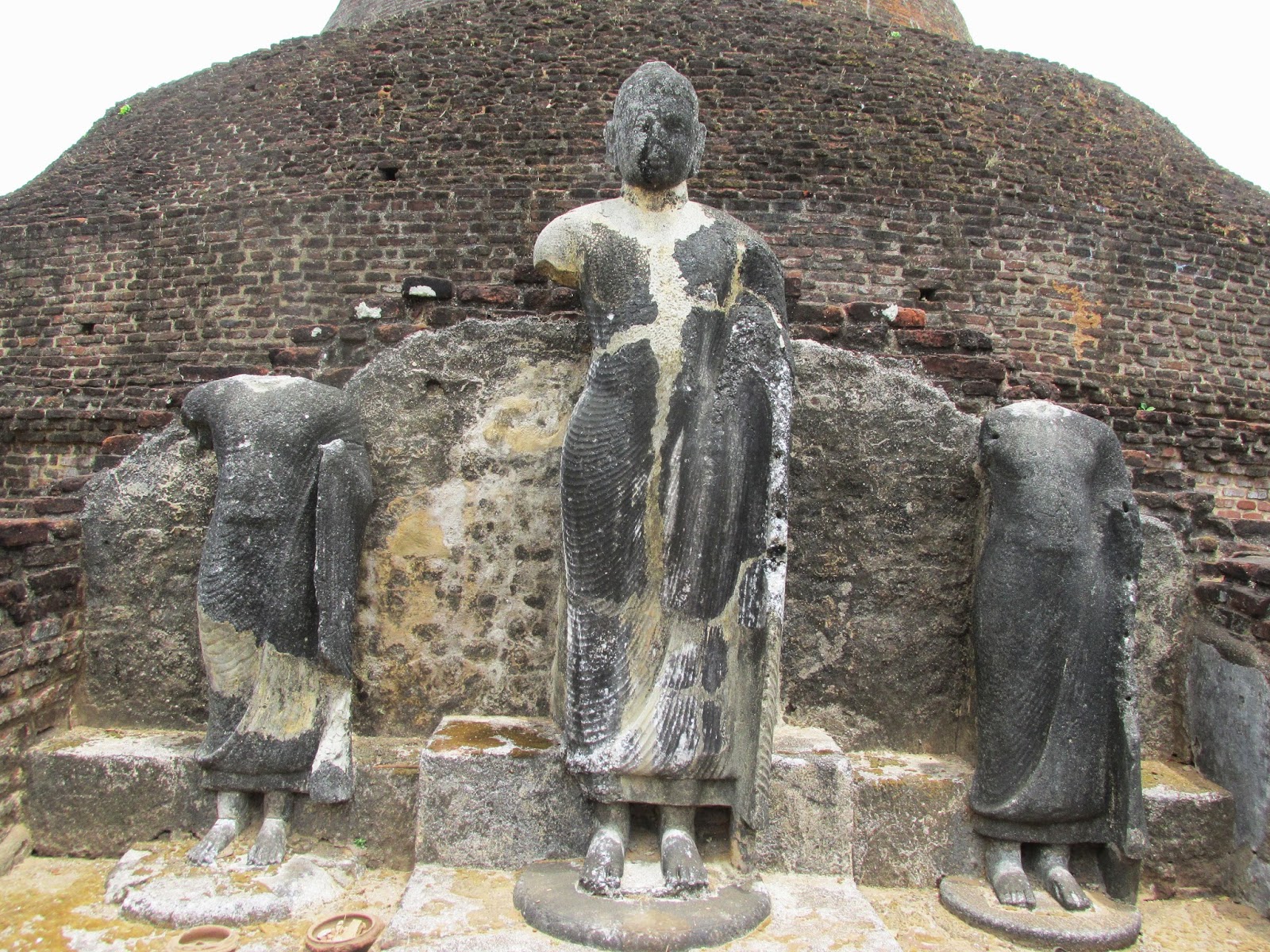


One building contains the remains of a large standing Buddha. It was interesting that people maintained quiet in that building, speaking in whispers.


Gil Vihara is a special site that is included in the entrance ticket. It is a large rock cliff in which several Buddha images have been carved. 

Since the rock is striated, I enjoyed seeing the continuing lines from the rock in the background to the Buddha images. 


There are three large Buddhas—sitting, standing, and reclining—on the sides of a smaller one in a carved out cave. This is where most people put flowers and prayed. I found it interesting that the eyes are closed, not just almost closed like they are in Buddha images in other countries.

Some flowers were put on the altar in front of the reclining, which is called recumbent here, Buddha. A monkey sat on the altar eating the centers from the lotus flowers. He was not hesitant like the ones I saw in Arunadhapura.


The last site is a huge image house with painted walls 


and a large standing Buddha. 


The painting is faint, but once my eyes adjusted I could make out figures in several places. The building is being renovated and is completely covered with scaffolding.


The early sites had a lot of venders selling various items. They were a bit pushy. I ended out doing my part to support a couple of them, though. One woman had small, metal items and was quick to notice that I had glanced at them. I ended out buying two—an elephant and a Ganesh—from her. Later, when I was having a coconut, a man convinced me to buy two more—a Buddha and a Hindu goddess. He was not pushy and his price was lower than what I ended out paying the woman. She was unhappy with what she got, and he was happy. Pricing is always a mystery.

For dinner I went to a restaurant on the main road in the other direction. It is a curry buffet with 18 different curries. I chose the vegetables only option. I thought about adding a piece of chicken, but when the man put a spoonful of 13 different curries around the rice, I knew the chicken would be too much. The quantity was just right for my meal. Curries included lentils, cabbage, pennywort/spinach, breadfruit, pumpkin/squash, green beans, coconut sambol, beets, potato and others I don’t remember.

Tuesday morning before leaving I went to the seamstress I’d bought a pair of pants from to ask her to sew the seam of the another pair of pants. She did. My other reward for going out was market day. Since I always enjoy markets, I was really happy to encounter that. On the way back, I walked through the food market. Many of the vendors smiled after I took a photo.

People: Sri Lankans come in all sizes and shapes. Skin shades are dark and darker, but they don’t seem to be obsessed with having lighter skin. I’ve seen only a few women using umbrellas in the bright sun. I’ve been seeing middle class or lower middle class people, not upper classes, which may make a difference in concern about skin color. I did notice that people on billboard advertisements are light skinned. People look at me cautiously, some with curiosity. I think they aren’t accustomed to seeing many foreigners, especially older ones. When I smile and nod, most will smile back. Children around age ten are the most openly curious. They stare and some will speak a greeting. From a distance they wave and say “hello” or “hi.”


Habarana and Minneriya (8-8)

Thursday I traveled to Habarana. Following the leisurely morning pattern, I arrived at the bus station at 11:05. I must have just missed a bus, as I waited on the bus for an hour before it left. The good aspect of that is that I got to choose a seat on the two-seat side rather than the three-seat side. Unfortunately, the woman who eventually sat with me needed a little more than half the seat; so we were snug for the two-hour trip. This was the most rural bus ride I’d had with frequent stops and lots of people. When the bus left, the aisle was full of people standing. Then more people got on at the next few stops. Loud music played the whole time. On the dashboard there was a statue of Ganesh along with the Sri Lankan and Buddhist flags. With the windows open, the temperature was comfortable when the bus was moving.

I arrived at the guesthouse at 2:30. This was one of my splurge guesthouses. It is in the woods near a lake. Instead of rooms, guests have a large cabin. 


Mine was the last one; so it faced the woods with no obstructions. It was lovely to sit on the patio to read and enjoy the natural surroundings. Since it was the end of the dry season, everything was brown. The guesthouse is family-run—the young man owner, his brother, and his father. I also noticed that two women helped with the morning cooking and cleaning the rooms.


In the evening, I walked along the lake and the road past it. The water level was low, but it was still lovely. In one place there are stairs leading into the lake. 


Women were washing clothes and bathing there.


Curry for dinner.


Friday morning, I returned to the lake before breakfast. Men were collecting lotus leaves. Later I walked past the lake the other direction. There is a small temple with a bodhi tree. 


And then there is another lake. 


A woman was bathing there, pouring water over herself for several minutes.


When I went back past the first lake, a group of children, mostly boys, were swimming at the stairs and a
woman was washing clothes. One boy had a big piece of Styrofoam to help him float and another made a floating device from plastic bottles. Tourists were arriving to ride around the lake in paired boats.

Breakfast was string hoppers, one of Sri Lanka’s typical foods. The strings are rice noodles and the hoppers, which are like crepes, are made with rice flour. The dishes were curried potatoes and coconut sambol, another Sri Lankan specialty. The dishes are mixed with the noodles and then can be wrapped in a piece of the hopper. There was also butter and jam to eat with the hoppers. I was glad to finally try this dish that I’d read about.


The activity of the day was a safari ride to Minneriya National Park. I had emailed that I wanted to do that and that, if possible, I’d like to join other guests. Thursday evening the owner told me that a British family—two older people and their daughter—had agreed to have me join them and share the cost. I was happy. We left at 2:00 for our adventure. This was the season when many elephants migrate to this park because it is dry and there is water in the park. So, of course, many tourists were also there. 


The types of trees along the road changed several times on the way in. 


We stopped to see a few chameleons and some birds. We also saw monkeys.


After an hour we saw our first elephants coming out of the trees. 


Then we reached the open area with lakes 


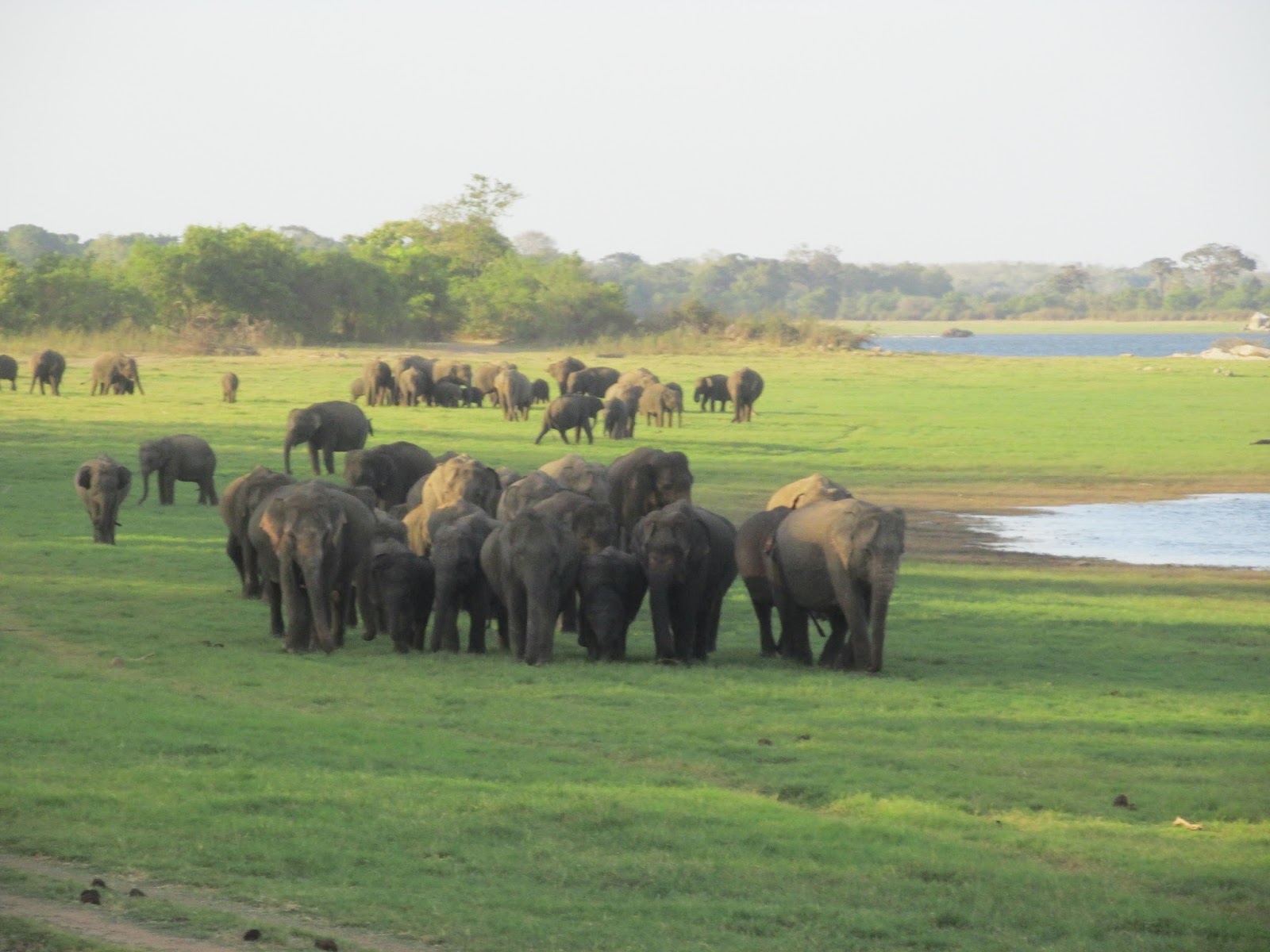
where the main groups of elephants were. There were elephants of all sizes. It was fascinating to watch them scrape the grass with their feet to loosen it so they could pick it up and eat it. 


I especially enjoyed the babies and watching the adults protect them. The driver said the smallest ones were about three months old. In the second area where the elephants were congregated, there were about half as many jeeps as elephants. We watched elephants in three different areas. 


When we were going to the last area, we came across two elephants that looked like they were doing some sort of ritual together. Then a third them for a short time and then left alone. The other two continued interacting for a while before returning to the group separately. When I asked about this, the man said that, if they seem aggressive, they are fighting but if they are not aggressive, it’s love. These two definitely looked like it was love. We were one of the few jeeps that stopped to watch this ritual, which also made it a special experience.


Eventually it was time to head back. As we headed back, the elephants were also heading back that direction on their way to another area where they go at the end of the day. They were on the move, not stopping to eat. The driver said they walk about 25 kilometers a day, eating 250 kilograms of grass. Our driver said we saw about 200 elephants.


When we got back to the first clearing, we stopped along with other jeeps to watch them walk by. People got out of their jeeps to have photos taken with the elephants. Our driver was more cautious and didn’t let us get out till most had passed. When a small group came and faced us, the driver hurried us back to the jeep, saying that one of those elephants is dangerous. They were clearly watching us carefully. From our safe place, we watched the rest of the elephants move on. 


Such a peaceful way to end our time with the elephants. And then we moved on—out of the park and back to the guesthouse. On the way out, we saw a bald eagle flying above us.


For dinner I had devilled fish. I’d seen “devilled” on the last guesthouse’s menu, but I didn’t know what it was and it was more expensive than other meals. Since, at this guesthouse, it is the same price as other dishes, I asked what it is and was told that it is fried. So I was expecting fried fish, but it was stir fried. I learned later that it is deep fried and then stir fried.

Saturday morning I hired a tuk tuk to go to Ritigala, an archaeological site from the 4th to 5th centuries BC that is near Habarana. I wasn’t familiar with this site, but I’d met foreigners on the bus who had come from there and it was in the “things to do” book at the guesthouse. My original plan had been to go to Sigiriya, but, since I’d already been there, I decided to check out Ritigala. When we went through town, we stopped at a vegetable stand while the driver talked to his sister. When we left, he said she was jealous because she’d never been to Ritigala. I said she could come with us; so she did. The tuk tuk ride to get to the site took almost an hour, partly on the paved road but mostly on the dirt road through the jungle, and part of that road was loose dirt since it was being improved and the new dirt hadn’t yet been flattened. 

At the site, the driver asked if I wanted a guide and, when I hesitated, said he would be my guide. He was a good guide and knew a lot about the site and showed me places and things I wouldn’t have seen otherwise. The site was a palace and then became a watch site during times of war. Then it became a monastery for about 500 monks. 


There are at least 17 palaces. We saw several, and one was labeled #17. 


One of the palaces has a urinal beside it. The driver/guide said it’s the only one outside Anuradhapura. 


There are also buildings that were a library and a hospital. The hospital had a pool and a sauna. 

Some of the path is the original paved “road.” 


In one place, he showed me the entrance to an underground tunnel that went to Anuradhapura. The area has several waterfalls, but, since this was the dry season, there was no water flowing. We were at the site for about two hours. 


In addition to seeing the archaeological sites, I enjoyed the opportunity to walk through the jungle. 


We saw a lot of strangler trees wrapped around other trees. He called these “double trees.”


As we were leaving, I saw a yellow chameleon on a tree; so we stopped to look at it. We waited several minutes for it to change color. It did become lighter but didn’t turn brown like one we’d seen earlier in the day and also on Friday. My driver/guide said it knew we were watching and wouldn’t change color while it was being watched.


Back at the guesthouse, the owner asked about my plan for the evening. My only plan was to relax and rest, as riding in tuk tuks makes me tired. I think it’s the shaking and rattling and the air blowing on my face. He suggested a massage. When I’d seen it listed in his book of things to do, I had thought about it; so I decided that this would be a good time for an ayurvedic massage. At 5:00, he took me to his cousin’s spa where he arranged a discount price and threw in a sauna and steam bath. All for 5000 rupees/$38. The treatment began with an hour-long body massage. She started with my head and back and then did the rest of the body. (It’s interesting how the different techniques work.) Lots of scented oil was used. The technique was mostly rubbing. After the massage, I had the steam bath lying on a layer of leaves in a covered container while she massaged my head. Next was the special head massage with oil that drips from a container onto the forehead and then is massaged into the head and face. Last was a dry sauna in a room where the floor was covered with the herbal leaves and they were also hanging from the ceiling. The treatment took an hour and a half and was wonderful. I was told not to shower for at least two hours to let the oil soak in.

After dinner I met the British family from the safari and chatted with them for a while before we retired for the night. It was good to see them again.