Saturday, September 26, 2015

Anuradhapura Part 2--Mihintale (8-5)

Wednesday I hired a tuk tuk to take me to Mihintale, a nearby recommended site. Tuesday evening when I asked the receptionist about hiring a tuk tuk, he talked to his boss, which seems to be how things related to money are done at this guesthouse, and returned with a “don’t tell anyone” special price of 1500 rupees/$11 instead of 2000/$15. I would have agreed to the higher price, but the discount—if it was really a discount, as I had been offered 1500 and 2000 rupees before—was nice.

I woke up tired Wednesday morning after the day’s exertion on Tuesday, but off I went at 8:15. I knew Mihintale involved lots of steps, but I had no other plan for the day; so it was OK. Mihintale is important because it is believed to be the site of a meeting between a monk and a king that resulted in bringing Buddhism to Sri Lanka.

When we arrived at the parking lot, a man approached and asked if I wanted a guide. He showed me his official ID and spoke English well. I liked him and I had wanted a guide someplace so I could learn a bit more than when walking around on my own. So I asked about his price. I had to ask three times to get a response other than that I could donate what I wanted. He then said he would take me for $10 or 1300 rupees instead of his usual 1500/$11. Hiring him was a good decision, as he is very knowledgeable and he took me places I wouldn’t have known about on my own. 

First we went to the meditation caves and the 1st century BC stupa at the top of a mountain. Since these are in the opposite direction from the main site, I wouldn’t have known to go there. There are a number of caves where the 2000 monks meditated. 


One of the caves has a grinding stone pit where herbs were ground to make medicine. 


The guide showed me the rain dripping ledges on the caves. I’d seen reference to these but hadn’t understood what they were or how they worked. A layer of rock was carved away leaving an overhanging ledge from which the rain dripped straight down to the ground instead of following the contour of the rock and going into the cave. I’d seen these on Monday at the caves at Vessagiriya but didn’t know what they were.


A unique aspect of the stupa 


is that there are pillars with a different animal on top of them to indicate the four directions. The animals are the same ones that are on the Moonstone—elephant, lion, horse, and bull. Each direction also has an altar and a pedestal with the Buddha’s footprints. 


Carvings on the stupa include Hindu gods and people making offerings to Ganesh in addition to the usual elephant heads. 


One wall has remains of original paintings.


Near the stupa the guide pointed out a black monkey called a bear monkey in a tree. These are different from the macaques.


Next we went to the monastery. One unique feature is a standing lion shower. Water came from above to the lion’s mouth, which monks stood under to shower. There is also a stone hole that was used for washing or dyeing robes. Jackfruit tree bark was used for the yellow-orange color.


The refectory is similar to the one at Abayagiri with a large rice trough and a smaller one for curry. Fire pits were used to cook the rice. Instead of sitting on benches in the refectory, the monks took their food and sat in the forest. The refectory has a water pipe for which water came from above. It also has a draining hole to take water underground.


From the refectory, there are stairs that go halfway up the mountain. 


There is a white stupa with columns around it. 


From that point, there are three places one can visit—all up more stairs: a stupa, 
a new Buddha statue, and the top of the rock. 


I decided that I didn’t need to see the stupa or statue up close and only went up the rock. 


For climbing up the rock, there are some stairs cut into the rock and some footholds. Fortunately, there is a strong pipe railing which I held onto the whole way. My guide was good about helping when needed and sometimes telling me where to put my feet. A sign informs visitors that the Great Stairway consists of 1850 rock-cut steps. I think this must include steps to all three of the monuments, and, since I went to only one, I didn’t go up that many steps. 


Of course, the views from the top of the rock are spectacular. There is a 360 degree view.


On the way down from the top of the rock, we stopped at a cave beside the path. This took some assistance to get to, as it’s off the beaten path. There is a flat rock on which a famous monk sat to meditate. When you get onto the rock, the place to sit is clear and easy to slide onto. The view from there is magnificent, making it a very peaceful place.

Since I had a guide, I remembered to ask about the painted palms on many Buddha statues. He said that it is something the artists do and that it has no particular meaning.

As we approached the parking lot, the guide mentioned his three children—17, 15, and 12— and the fact that there weren’t many tourists and asked if I was happy with his service, the hints for a tip. He was pretty low key about it, though. When I asked if the oldest would go to university after this year, he said she will take the university entrance exam in December. Education is free, but of course there are expenses for such things as housing, food, books, and uniforms. He is a good man, and I was glad to have used him as a guide.

I arrived back at the guesthouse just after noon, having been gone for four hours. I was tired; so I relaxed for the rest of the day. I had thought about going to the new town, but on the way back we drove through it and I realized that there wasn’t anything that interested me. So I was happy to enjoy my room and the garden where I took advantage of the hammock I’d been eyeing. I enjoyed relaxing in it for a couple hours before dinner time.

For dinner I decided to try the “grilled chicken with French price.” When I first saw this on the menu, I couldn’t figure out what it was, but the price was the highest item in the group. Later I noticed that a sandwich was also served with “French price” and realized that it was “French fries.” The meal was delicious and it was really nice to have fries instead of rice, which I was tired of.

Snack stands sometimes advertise “cool drinks.” And they mean cool, not cold. They are at a lower temperature than outside but are not cold. Most drinks are carbonated drinks, but I did find one stand that had juice that was good. The drinks come in glass bottles. My favorite is ginger beer.


Anradhapura Part 1 (8-4)

After arriving at the guesthouse early Monday afternoon, I had an avocado and banana drink while relaxing. Then I talked to the young man at reception to make a plan for the afternoon. Using the map I was given in Colombo, I chose a few places outside the main Sacred City areas and asked him to call a tuk tuk. He talked to his boss who came to talk to me and introduced the driver. I learned that you have to purchase a ticket to the sites that is good for only one day; so I didn’t want to do that for half a day. The driver said that four hours was enough, but I know myself and knew that four hours wouldn’t be enough time. He then tried to sell me a ticket someone had used that day and had given him. The deal was that I pay for the ticket (3500 rupees/$26) and he’d give me the tuk tuk (2000 rupees/$15) free. I had to be firm that I didn’t want to pay for the ticket when I had only half a day to use it. I then told him my original plan, and he agreed to drop me off at the farthest site from which I would walk to others.

My first stop was Vessagiriya. The driver was nice and pointed out which way I should walk to go to the next site. I was thrilled to walk around, this being my first of the ancient sites. It was a forest monastery where monks lived in caves starting in the third century BC. There are remains of houses as well as caves where the monks meditated and/or lived. I was enchanted. 


I liked the entrance stairs into what is left of the houses. It leaves one to imagine. 


One cave has the remains of a door frame, which I always find fascinating. 


One tree was full of monkeys that were fun to watch. 


There was also a large group of them on the path to the parking lot. I carefully walked around them, as a couple were watching me intensely and I didn’t know if they would become aggressive like other monkeys I’ve encountered. They didn’t.


Nearby is Isurumuniya, an ancient—3rd century BC—temple in a rock. The museum has a collection of carved stones with dwarves. The dwarves are often at the base of a building holding it up. 


The temple stairs have these, too. I remembered seeing them in the museum in Colombo, and this helped me put them in place. 

When I was going to the temple in the rock, a man asked me if I could take a photo. I waited to be given a camera and then realized that I should use mine. This was curious. After I took a photo, he asked how I could send it to him, and I took their email. I remembered taking photos in the past and mailing them to people, but this was the first time I’d been asked to email one. It’s easy; so I’m happy to do it. I chatted with him and a young woman for a while. They are brother and sister, and the group was their family—sister, mother, husband, wife, etc. who were having a short holiday together. 

One of the things Isurumuniya is known for is carvings of elephants in the rocks at the edge of the pond. 


The site also has a bodhi tree surrounded by a shrine. 


And you can walk to the top of the rock where there is a stupa and a good view of the surrounding area.


Next I continued walking down the street and came to a Pilgrims’ Rest. I’d noticed a few of these on the map. This one has a huge Buddha statue. I realized that the roof was what I’d seen from the top of Isurumuniya. Many people wearing white clothes and carrying flowers were there. After several minutes, they formed a line and started walking down the street. I didn’t know what was going on.


Next along the road is Dakkina Stupa, which is of interest mostly because it has not been reconstructed.


Continuing down the road, I wasn’t sure where I was going. Then at a split in the road I saw a sign with English pointing to the right side of the split and crossed the street to go that way. A policeman was blowing his whistle and then came over to me and demanded to know why I was crossing the street there when there were crosswalks twenty meters away. I hadn’t noticed them. When I passed one, I was looking ahead and wasn’t planning to cross the street. When I looked carefully to cross the street, I didn’t see it, as it wasn’t that close. In the more rural area I wasn’t thinking about the crosswalks like I did in the city. The policeman was being intimidating and demanding. When I told him that I honestly didn’t see the crosswalks, he demanded my passport, which I didn’t have with me. He wasn’t happy about that. I gave him the copy I carry with me, but he just said it’s a copy and wanted to know where my passport was. When I told him it was at the guesthouse, he demanded to know what guesthouse; so I showed him my paper. When he asked where I was going, I pointed down the road. He told me it went to Sri Maha Bodhiya. It was an honest mistake on my part, but I learned that they take the pedestrian crosswalks seriously here. The policeman didn’t need to be so demanding, but I think he wanted to intimidate me. I thought he was going to ask for money, but I didn’t feel intimidated.

Sri Maha Bodhiya, the sacred bodhi tree in Anuradhapura. It is a descendant of a piece of the bodhi tree under which the Buddha was enlightened; so it is considered to be holy. The people who had walked out of the Pilgrim Rest were going there. Shortly after I entered, I was surprised to see the French family. He said that they had been told that many people go there to pray at 6:00. It was 5:20, and people were starting to arrive. 


The site has many bodhi trees surrounding the special one, which has a building around its base. It was planted in 249 BC and is the oldest living human-planted tree in the world that has a known planting date. The trees have Buddha statues under them and flags around them or in them. People go to one low branch to touch it and pray. People fill jars with water and pour the water around a tree. 


Many bring flower offerings for the temple. Everyone wears white.


I took a tuk tuk back to the guesthouse and then it was time for dinner. I wanted a light meal, but the only light offerings are sandwiches, which I didn’t want. So I ordered the vegetable curry. It came with rice and six small dishes of vegetables—cabbage, spicy bitter gourd, breadfruit, green beans, green peppers, and lentils. As usual, I ate about a third of it. This was the first time I’d had breadfruit, which tastes similar to potatoes. The bitter gourd was a little spicy but that removes the bitter taste that it usually has.

Tuesday I rented a bicycle to go around the Sacred City. I like the independence of not having someone waiting for me and being able to meander at my own pace. First I went to Jethawana, as that is where tickets are sold. The triangle ticket includes three major sites: Jethawana, Abayagiri, and Samadhi; so my plan was to visit these three places first.  The Jethawana Museum has a nice collection, a highlight of which is the special treasures—jewelry, small Buddhas. A nice feature of that room is that it is air conditioned. Jethawana is a 3rd century monastery. The dagoba/stupa is the largest in Sri Lanka. It is made from red bricks and is the tallest—400 meters originally but now only 70—brick monument in the world. Over a million bricks were used in its construction. 

Elephant heads jut out of two layers alternating with lotus flowers all around the stupa. After visiting more sites, I realized that these are typical of Arunadhapura architecture.


Inside the stupa is a temple.


Outside the stupa there are remains of houses and other small buildings. Since these were my first such remains, I was fascinated by them. When I was walking around this area, a young man started to talk to me, telling me that he is a student and is studying to be a cook. When he said he could take me around, I asked how much. He said it’s complicated because he’s a student. He hung around with me and followed me on his bicycle back to my bicycle and then rode along with me. When I stopped for a drink, I told him I wasn’t going to pay anyone to take me around. He kept stating that he likes to meet foreigners and is a student and his parents can’t support his education. He told me that people have given him money because he’s a good person. This was getting old. I repeated that I wasn’t going to pay anyone and that most people who have helped me have wanted money. He explained again that he is a student and showed me his student ID card, which expired four years ago. After we left the shop, he asked what I thought about his going with me. I ignored him and just rode ahead. He didn’t follow. I guess he wasn’t just helping and being friendly after all, which was no surprise.

The Sacred City area has a number of sites to visit. First I stopped at the Twin Ponds, which were bathing ponds and are quite beautiful. 


Next was the Samadhi Statue, a 4th to 3rd century BC Buddha statue that is considered to be quite special, perhaps because it is so old.


Then I went to Abayagiri, a monastery that covers most of the Sacred City area—about 500 acres. I spent a few hours riding and walking around this area. It was built in the 1st century BC and was in use up till the 12th century. I learned later that about 5000 monks lived there. The whole forest is covered with remains of houses.


The stupa is similar to Jethawana Stupa with its red brick construction.


Lankarama Stupa, built in the 1st century BC, is different. It is white and is surrounded by rings of columns that used to support a roof. I loved these. The column tops are decorated with dwarves, which I enjoyed seeing outside a museum.


After visiting Lankarama Stupa, I rode to see the Moonstone. When I stopped, a man told me to park the bicycle at his small cafĂ© and then I could have a drink or roti when I returned. Since I needed both, that was a deal. The Moonstone is a beautiful, very well preserved half circle that is at the base of stairs. This one is from the 10th to 8th centuries BC and is described as the finest specimen in Sri Lanka. It’s enclosed so people can’t walk on it. 


After viewing the Moonstone, I stopped for a ginger beer (ginger ale) and banana roti.


Then I crossed the street to see the Guardstone, a very well preserved guardstone that is also enclosed for protection. Guardstones are at the base of stairs and at entrances and usually have carvings of Hindu goddesses. I first saw guardstones and moonstones in the Colombo museum, but visiting these sites made me appreciate them.


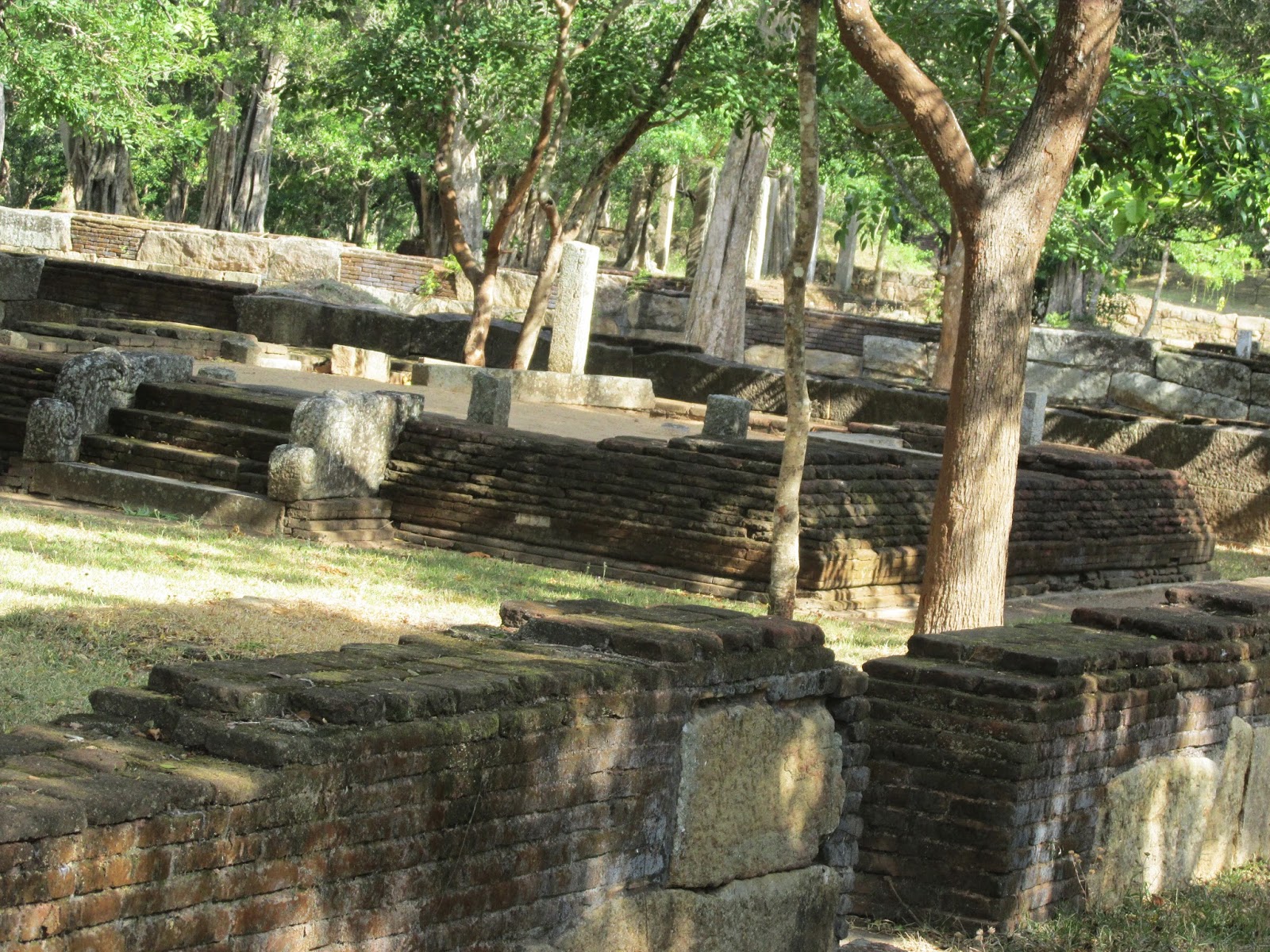
Riding on, I encountered more of the monastery’s various buildings, mostly residences. I was enchanted by them. In one area, I was drawn in by a door frame. Beyond it is a pond. 


Then I saw what looked like perfect columns. As I headed toward them, I heard someone speak to me. A vendor I’d met briefly in the morning had seen me walking and had come to talk to me. He told me I am different because I was walking in this area and taking lots of photos while most people don’t stop there. He pointed out another set of well-preserved guardstones. 


When I commented on the different shape of a few of the remains, he said they were probably stupas. This was one of my favorite areas of the monastery, partly because it was so quiet and is full of interesting remains


Next to that area there is another Samadhi Buddha. After stopping there briefly, he took me to Elephant Pond, which I wouldn’t have found without him, as it’s off the road and isn’t marked. Elephant Pond was the bathing pond for the 5000 monks who lived in Atayagiri. It’s huge. 

On the way, we walked through the Refectory, and he explained the various sections. This is where the monks ate. A very long trough was for their rice, and a smaller one was for their vegetables. There is a chicken house. After getting their food, the monks sat on benches.


After returning to my bicycle, I suddenly felt tired and ready to crash soon. It was time to return to the guesthouse, which I knew would be a ride of about half an hour. The man had talked about how he likes to speak English. He offered to take me on his motorcycle to Mihintale and a couple other places on Wednesday for no money—only a beer. Although I enjoyed his company and information and his not being overtly pushy, I wasn’t comfortable with the “no money, only a beer” arrangement. I like things to be up front. So I turned down his offer. When I said I was tired and needed to return, he said, “no beer?” I apologized and said I was too tired, which was true. I was also too tired to make the translation from ”beer” to a monetary tip, which I felt a little bad about later as I learned a lot from him that I wouldn’t have known otherwise.


On the way back, I stopped at Thuparama  Stupa, since I rode right past it and it was on a list of recommended places to visit. It’s similar to Lankarama Stupa in that it is white and has columns around it. It is important because, built in the 3rd century BC, it was the first stupa in Sri Lanka.


By this time it was almost 6:00 and people were bringing flowers to the altars. Monkeys were running to the altars and taking flowers and then running off to eat them. I think they knew the flowers weren’t for them because they would stop and look around before grabbing a flower and running off. They were amusing to watch. 


Near the stupa there is a pair of lovely guardstones and remains of another old stupa.


From there, I headed back and was pleased that I was able to get back to the guesthouse so easily. I had been out for nine hours. A good day, but I was tired. My room had been changed, as promised, and the new room was much nicer than the first one. When I arrived, all the first floor rooms were taken; so I was given a second floor room that I think is only for overflow and may usually be used by staff, as the room next to it was used by staff. Since I didn’t want a huge meal again, I ordered vegetable chicken soup that was quite tasty.

Sri Lanka is a male-dominated country. It’s men who work in the shops and guesthouses. Other than the homestay in Dambulla, all the guesthouses have been staffed by men only. I’ve seen only a few women working in the shops. I was happy to see that women were working at the two museums in Anuradhapura.