Friday, September 25, 2015

Wilpattu (8-3)

After a leisurely breakfast—roti, pineapple, and bananas, I left Dambulla heading to Wilpattu. The tuk tuk driver who took me to the bus station thought I should look for a Sri Lankan husband. In fact, he asked for my phone number so he could help with this project. I told him I didn’t have a Sri Lankan number. The bus trip took two buses—one to Anuradhapura and another to Wilpattu Junction. The first bus was full; so I had to stand for twenty minutes. Then, when an older man got off, he made sure I got his seat and he made sure one of the Dutch women sat with me, which was sweet. This was a lower class bus than the one I took to Dambulla, which had four seats across and had air conditioning. This bus had five seats across and no air conditioning, but with the windows open that was OK. And the trip cost half as much as the first trip. When we got to Anuradhapura, a man asked where I was going and said I should get off and take a tuk tuk back to the old bus station. So I got off. Not too surprisingly, he also got off and grabbed a van to take us to the bus station so he could show me his guesthouse near the station, thinking that I could stay there when I returned. (He didn’t ask if I had a reservation anywhere.) He made sure I got on the right bus and then had me pay the driver. I was expecting that I would have to pay even though the trip to the bus station was two minutes farther than to his guesthouse where he was going.

Another hour later, the bus dropped me off at Wilpattu Junction. While I was trying to call the guesthouse owner who had said he’d pick me up at the Junction, the man who lives in the house I was in front of came to help. When the phone call didn’t work, he hailed a tuk tuk to deliver me to the guesthouse. Since it was only 1:30 when I arrived, I had a lot of time to relax and enjoy the jungle environment. At 4:00, I went for a walk. I walked down the local street until three barking dogs blocked the road, which made me turn around and head for the paved road. 


I walked past a school with several small buildings with classrooms. 

Always a teacher, I had to look into them, which was easy since there are no windows. Because it was the summer holiday, the rooms were a bit disheveled, but I could get a sense of what they are like. 


Farther along there is a small temple with a bodhi tree. 


As always, I enjoyed walking past the golden rice fields which were especially beautiful in the late afternoon light. They pulled me back to memories of rice fields in Thailand. And memories of the fields in Nebraska and Iowa. Two crops of rice are grown in a year. 


The current crop had just been harvested, and rice was drying on the road, making it a one-lane road in these places. People were sweeping it into piles which were then scooped into bags. Monday afternoon the road was lined with filled bags. 
I also passed a cemetery. Beside it there are some interesting poles around the remains of a fire. I asked the guesthouse owner about these and learned that it is a cremation site. Old people—55 or 60 and above—are cremated; younger people are buried. Ashes from cremation are put into a jar that is put in a monument. It was a lovely walk.

Back at the guesthouse, I read on the patio until dinner, enjoying the birds and trees. Dinner was another delicious Sri Lankan meal—noodles and chicken curry. When I commented on the large quantity of noodles—enough for three people, the owner said that Sri Lankans eat a lot.

Monday was safari day at Wilpattu National Park. Departure time for my full-day safari was 6:00 AM. On the way to the park entrance, we caught the sunrise. 


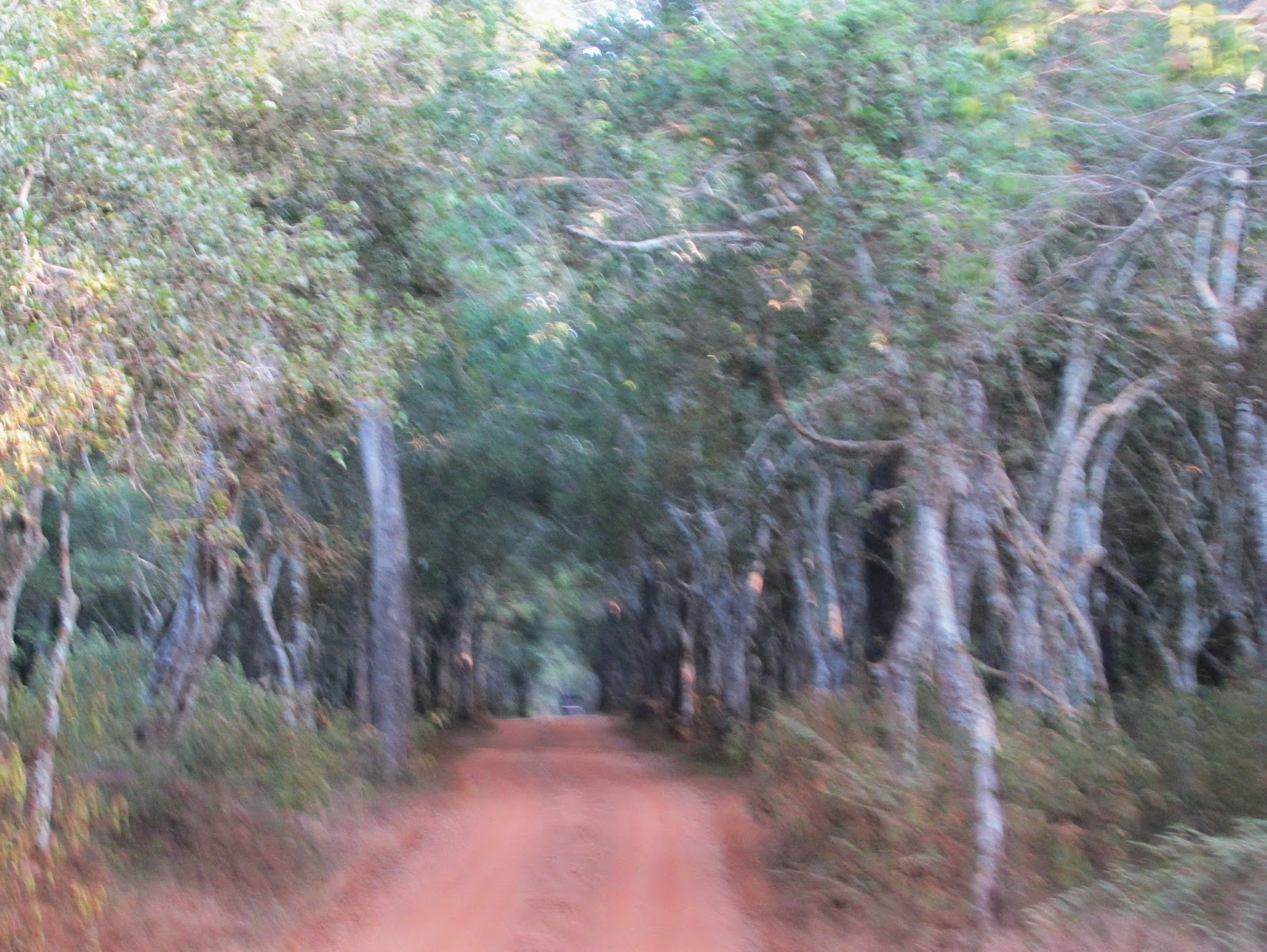
This was a jungle safari, going through trees most of the day. There were several different types of trees in different parts of the park. 


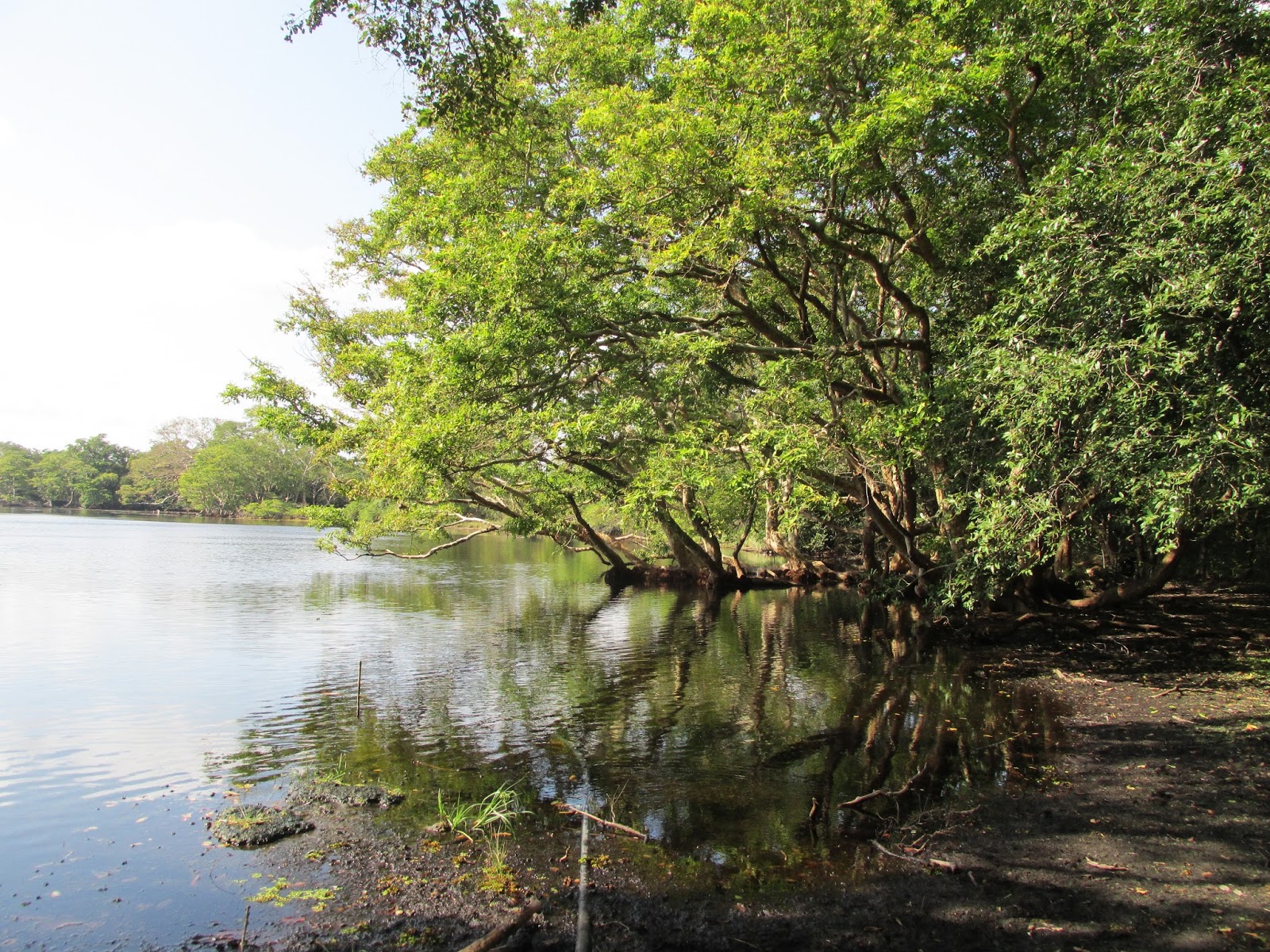
This is a wetlands park, which means that there are a lot of lakes and marshes that were lovely. 


There were a lot of different types of birds in these areas. My favorite was one that walked with its beak in the water moving quickly. 


Throughout the day we saw a lot of peacocks walking around. The first wildlife stop was a pond where I was told there was a crocodile. It must live there, as several jeeps drove to see it. It eluded me, as I was unable to see it. 


At the next lake, I was taking photos of birds standing near a fallen branch. After a couple minutes, I realized that the branch was a crocodile with its mouth open. My driver hadn’t pointed out this one.


During this part of the trip, there were a lot of jeeps. Sometimes they were spread out; sometimes they were clustered. When we arrived at the rest area for breakfast at 9:00, ten jeeps were parked there. When we first arrived, there was a report of a leopard nearby; so several of the jeeps went onward, but the leopard had also moved onward by the time we got there. So we went back to eat breakfast. 


After eating, I walked down a path that goes to a lake. It was a beautiful, peaceful place to spend the rest of the hour-long break. 


When I walked near the water, the small dots above the surface became frogs that jumped really quickly—almost like skipping on the water. Then they settled again with only their eyes above the surface. They were fascinating to watch.


After breakfast, the half-day safari jeeps turned back and we didn’t see so many together again. My jeep stayed close to another one most of the day. Most of the three hours between breakfast and lunch were spent driving to a number of lakes to see what was there. Many of these had lovely, purple flowers. We saw more birds. We stopped to climb a tree for a bird’s eye view of the area.


Morning mammals sighted were a couple types of deer 


and a buffalo.


At 12:30, we stopped at the same place for lunch, which was almost a two-hour break, which I’m sure the drivers needed. The guesthouse owner had mentioned that there would be a long rest time because the animals are not out in the afternoon. There were only five jeeps at this time. My packed lunch was chicken and vegetable curry. A plate was packed with it, but I ate from the Styrofoam box. I didn’t want to bother putting the food on the plate, but it was a nice touch. After eating, I headed back to the lake to enjoy the peaceful atmosphere and watch the frogs.

Back on the road, we continued driving through the jungle and checking out the lakes to see what was there. 


An hour later we scored an elephant in one of the lakes. It was eating the grass; so we watched it for a while. 


We also saw a huge reptile—some kind of lizard. 


And a few more birds. 


And one more crocodile. No leopards. When we were on the tree platform, a woman told me that it’s hard to see leopards at this park and that I would be more successful at Yala. We’ll see.


We arrived back at the guesthouse at 6:00. We were driving for 8.5 of the twelve hours; so I imagine the driver was tired. By the end of the day, I was tired of bouncing on the road with the air blowing in my face. I enjoyed the trip, but I was ready to return to the guesthouse when it was time. It was a long day, but I was glad I did the all-day safari. It was good to be out in nature and to see so much. When I washed my face and then dried it, the towel was brown.

The owner gave me a pot of tea when I returned. So I sat on the patio drinking and reading. A French couple was there, too. The man and I chatted about the safari as they were going on Monday. When dinner was served, he invited me to join them inside, and I learned that they had their two sons along. They have been living in China for 3.5 years; so we had that experience in common. It was fun to talk with him/them.

In the morning, I had toast (cold) with jam and “fat spread.” Somehow “butter” is much more appealing, but “fat spread” is appropriate. The guesthouse owner sat and chatted with me while I ate. The guesthouse is his original family home where he was born. He and his family—wife and two children—live in town. He was a policeman and then was in the army during the years of the civil war. He was injured and told to stay home; so now, starting before age 48, he receives a government pension.

The civil war ended in 2009. Since then the country seems to have built itself up quite a bit. Tourism is starting to thrive. Dutch people I’ve met mentioned that recently there were two TV programs about Sri Lanka, and the result is that many Dutch people have decided to visit the country.

Note: In the evening at the sacred Bodhi tree in Anuradhapura, I met the French family. They hadn’t seen many animals on their safari, either. However, they did see a leopard’s paw print.


Dambulla and Sigiriya (7-31)


Note: I apologize for the lack of complete photos. There seems to be something wrong with this post, and photos will not completely upload to the public site. Since other blogs are posting, it seems to be a problem with this one and I don't know what else to try. 


Wednesday, after a leisurely morning in my room, I left Colombo on the 11:50 train to Kurunegala. (There were two earlier trains at 6:50 and 8:50, but I wanted a relaxing morning.) With the windows open and fans going, the train was comfortable enough. At 280 rupees/$2, it was certainly economical. My seatmate was a nun, who is a retired principal and who was going to visit her family. When I thought I heard the attendant say “Kurunegala,” I started to leave, but she told me it wasn’t my stop; Kurunegala would be next. After half an hour, I figured out that I had been correct and I’d missed the stop. But I knew the train would stop in Anuradhapura and I could get a bus to Dambulla from there. That worked out very smoothly, and the trip took only an hour longer than planned. 

In Dambulla, I took a tuk tuk to the guesthouse. We stopped at the fruit market so I could buy some rambutans. Also so he could suggest that I hire him to take me to Lion Rock in Sigiriya on Thursday. The young man was nice and not pushy, explaining that there weren’t many tourists and he has two children. Since the price he suggested (2000 rupees/$15) for the round trip, I agreed. It may or may not have been, but it was OK with me, which is what is important. He didn’t want me to tell the guesthouse owners that I was going with him because sometimes they have their friends whom they like to recommend and don’t like guests to hire a driver on their own. When I left in the morning, it didn’t seem to be a problem.


After traveling for six hours, I was ready to arrive at the guesthouse, and I was hungry. I ordered chicken kottu, which the woman made for me. I had to look up what kottu is, as she couldn’t explain it in English and I couldn’t tell exactly what it is. It’s very small pieces of roti mixed with chicken (in this case). It was quite good, but the portion was way too much for me. Kottu is one of Sri Lanka’s recommended dishes.


Thursday morning I met the driver at 7:30 so I could do the walking up the rock before it got too hot. It worked out well. Ancient Sigiriya was a city with a 5th century palace on top of a 180 meter high granite rock that juts out of the plain. A series of stairs, totaling 1200 I was told, guide people to the top. They were quite manageable. Some boulders have ancient handholds/steps, making me thankful that things have been modernized.


The ancient city surrounded the rock, and there are foundations of many buildings around the base of the rock. There is a series of water gardens along the path to the rock. Most didn’t have much water, but apparently they do during the rainy season. There is also a boulder garden at the base of the rock. A sign explains that these gardens are among the oldest historical gardens in Asia.  are the one of the oldest continuously growing gardens in the world.

As I was walking along the path to Lion Rock, a man joined me and started telling me about the area. I knew he was what is called a “helper” who would want money for helping me, and I didn’t feel like listening to someone all the way up and down. After several minutes, I stopped and told him that I didn’t want to pay anyone. He also mentioned that there weren’t many tourists and he only wanted $20. I managed to shake him off. As I walked up the stairs, a hand often reached out to help me—even if I didn’t need or want help. More “helpers.” Although I had to tell a few that I didn’t want help, most left me alone when I said I was OK and ignored them. 

About half way up the rock, there are paintings on the walls of a cave. These are accessed by two spiral staircases—one up and one down—enclosed in cages. The open side of the cave is covered now to protect the paintings. 


They are truly magnificent. Most of them are women or apsaras. 


After viewing the paintings, the walkway goes along the Mirror Wall, which is a vertical side of the rock that used to be polished so well that it was like a mirror. The wall was used for graffiti and has poems etched into it. For protection, it also has a wall on the outside of the walkway. Because of the sun’s glare, I wasn’t able to make out any writing on the wall.


The next feature on the way up is the Lion’s Paws at the base of the Lion’s Staircase that leads to the top of the rock. These features are the basis for the name Lion Rock. 


The remains of the palace are on top of the rock. 


There is a large pool as well as many walls. 


The views from there are stunning. The wind was fierce. I walked around there for about 45 minutes before heading back down.


An extra treat at the top was watching a snake eat a frog. When I arrived at the site, only the frog’s legs were visible. They quickly disappeared and we could see it working its way down the snake’s body. I’d never seen a snake consume something like that before.       


The trip to the top and back down took almost four hours. On the way down, there is an Audience Hall with a throne on top of a flat rock. 


There’s a cave that was for monks’ meditation. 


And there’s Cobra Hood Cave, a cave guarded by a stone shaped like a cobra’s hood.


My driver met me at the Cobra Hood Cave. He was looking for me as I’d taken a longer time than he had anticipated. On the way out, we stopped for a photo of Lion Rock. 


Then he took me to a cafĂ© for lunch—vegetable roti and papaya juice. Roti is another recommended dish. I have enjoyed the fresh fruit juice that is available here. I remembered to give the driver a tip since he was good and I had taken more time that he had suggested it would take.


On the way back, we stopped at a spice garden. He explained that there is no ticket; I would just be given a tour of the garden. I knew from past experiences at such places that there would be a shop, and it’s probably a place that gives drivers a kickback. When we arrived, I was given a small cup of spice tea that was delicious. I chatted with a Dutch couple while we waited for a guide. The tour was interesting, as he explained each plant and its use for healing or taking care of the body. He gave each of us a piece of the leaves to smell and passed around various balms for us to smell. I hadn’t realized that the leaves carry the scent as well as the seeds. Since I enjoyed the spice tea so much, I bought the mixture.

 
By that time, I was more than ready to return to my room. A nap was in order. After resting, I went out to make sure the museums would be open on Friday and walked around the outside of Golden Temple of Dambulla for a while. The temple features a huge golden stupa, a building modeled after lotus flowers with a lion entrance, and a huge—30 meters high—golden (gold plated) Buddha behind the building. I learned that the golden Buddha is the largest of its style in the world. 

Leading up to on the side of the mountain there are many statues of monks approaching the Buddha with offerings.


Then I headed down the street to find a place where I could buy a SIM card. That took a while, but I did find a shop and bought a SIM card. It seems like a good idea to have one for safety and in case I need to contact a guesthouse. I walked past the fruit and vegetable market and bought more rambutans and a red banana. The man at the spice garden had told us about them, and I wanted to try one. They are a little sweeter than yellow bananas but not as sweet as the finger bananas. I also passed a warehouse area for vegetables. I read later that Dambulla is a center for growing and distributing vegetables around the country. After buying the SIM card, I was ready to ride back to the guesthouse. For dinner I had a nice vegetable curry. She cooked carrots, green beans, and black-eyed peas separately so I could mix them with rice.

 Friday morning I had a bit of breakfast before heading to the temple. It was a potato-like tuber that was boiled. When he first showed it to me, it looked like a sausage. When I said I don’t eat meat, they laughed and explained that it’s a Sri Lankan vegetable. It came with a side of pineapple. I also had milk tea, which I had enjoyed in Colombo.

 
At 10:00, I headed to Golden Temple and started with the Buddhist Museum. It has a number of Buddha statues donated by different Buddhist countries in Asia. Then I went to Dambulla Rock Temple, having no idea that it is at the top of the mountain. The views across the valley with prickly pear cacti on the side of the mountain reminded me of Arizona.


On the way up, there was a family of monkeys on the wall beside the path. It was fun to watch them groom each other and to watch the little ones playing.


Rock Temple consists of five caves. The caves were used as a Buddhist monastery as early as the 3rd century BC. The oldest cave paintings date back to the first century BC. Beside it there is a small Hindu shrine where priests bless people and tie string around their wrists. Inside, a boy was tying cloth on poles with lots of tied cloths while the priest blessed him. 


The other caves became decorated shrines from the 5th to the 13th centuries. The second and largest cave has a container—enclosed in a cage—that collects sacred water that drips from the ceiling and is used for special ceremonies. In the 18th century, the caves were restored/repainted. 


The main features of the caves are the numerous Buddha statues and the painted walls and ceilings. I was mesmerized by the paintings everywhere.


The outer buildings were added to the complex in the 19th century.


After visiting Rock Temple, I stopped briefly at the Painting Museum. It’s small but has explanations in English about the development of painting styles in Sri Lanka. Having seen a few of the styles and liking paintings, I enjoyed seeing and learning more.

 Thus ended my sightseeing in Dambulla. The driver, not knowing I had two days to see the sights, had suggested that I go to Lion Rock in the morning and Rock Temple in the afternoon. In past years, I could have done both in one day, but those days are over. I’m glad I have the time to do the things I want to do at my slow pace, and I have learned to enjoy doing things more slowly and relaxing more. I spent the rest of the afternoon relaxing in my room.

 It is dark here by 7:00.